Aging Population & Electric Wheelchair Demand: What the Numbers Actually Say
A data-backed look at how global demographic shifts are reshaping the electric wheelchair market — and what it means for distributors, importers, and electric wheelchair wholesale suppliers positioning themselves ahead of the curve.
The Demographic Shift Nobody Can Ignore
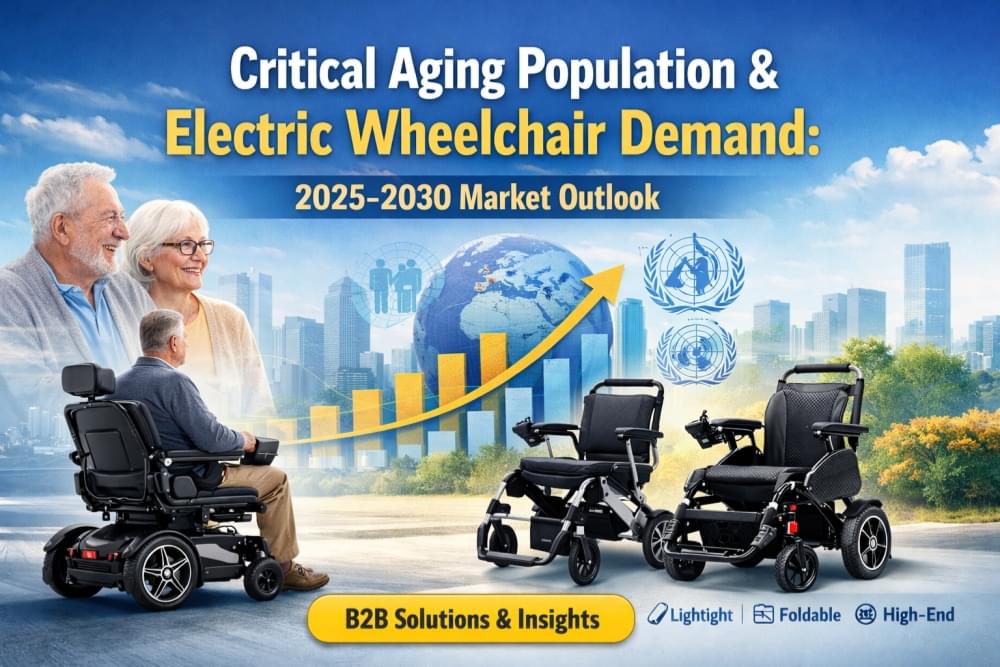
The global population aged 60 and above reached 1.1 billion in 2023. By 2030, that figure is expected to climb to 1.4 billion — roughly one in six people on Earth, according to the World Health Organization (February 2025). Global life expectancy now stands at 73.3 years, up 8.4 years since 1995. Living longer, however, does not mean staying mobile.
For businesses involved in wheelchair import from China, the timing matters. Demand is not building toward some future inflection point — it is already here, and it is concentrated in the markets that drive the most volume: Europe, East Asia, and North America. These three regions account for the bulk of powered mobility device consumption, and each is aging on a compressed timeline.
The electric wheelchair market growth in 2026 will not come from a single driver. It will come from the structural reality that hundreds of millions of people are entering the age bracket where mobility assistance shifts from optional to necessary.
Global Electric Wheelchair Market Size Trajectory (USD Billion)
Source: Grand View Research 2024. CAGR 12.3% (2025–2030). Estimates for intermediate years are linear interpolations.
Grand View Research puts the global electric wheelchair market at USD 4.49 billion in 2024, growing to an estimated USD 9.05 billion by 2030 — a compound annual growth rate of 12.3%. Fortune Business Insights independently estimates the 2025 market at USD 2.74 billion, expanding to USD 3.02 billion in 2026. Both figures point in the same direction.
For an electric wheelchair OEM manufacturer, this is not abstract market research — it is a direct read on where orders are heading. A wheelchair OEM supplier in China that already holds EN 12184 certification and meets MDR compliance is not chasing opportunity; it is positioned at the exact intersection where regulatory readiness meets accelerating demand. Europe is not one market opening up. There are several, moving in the same direction at roughly the same time.
Three Conditions Driving Procurement Decisions
Aging populations explain the direction. They do not explain the purchase order. What matters equally is what sits between a demographic trend and a confirmed shipment — the specific medical conditions, reimbursement policies, and clinical protocols that actually trigger procurement. These are the variables that turn a market opportunity into a purchase decision.
The decisions made by healthcare systems, insurance funds, and institutional buyers come down to specific diagnoses — conditions that reliably remove a person’s ability to walk independently, and in most cases, permanently. When that happens, a power wheelchair is not a luxury consideration. It becomes the primary mobility solution, and the procurement follows. For any distributor building out an electric wheelchair product range, knowing which conditions drive volume in which markets is more actionable than any headline market figure.
Cardiovascular Conditions
Stroke is one of the most common causes of adult disability worldwide. Survivors often deal with hemiparesis — weakness on one side of the body — that makes self-propelled wheelchairs unworkable from the start. Post-stroke patients tend to need powered mobility early in their recovery, sometimes from day one. Across Europe, this translates into steady demand from hospital systems, rehab centers, and home-care providers — a pipeline that does not dry up.
Musculoskeletal Disorders
Among adults over 65, osteoarthritis, osteoporosis, and hip fractures are not unusual — they are common. A fractured neck of the femur in an older patient is often the point where independent walking stops, and wheelchair use begins, sometimes permanently. Across several European countries, orthopaedic surgeons are now recommending powered chairs as the standard follow-up to fracture surgery, rather than offering manual chairs as a first option. This shift is already showing up in institutional procurement specs.
Neurodegenerative Diseases
Parkinson’s disease, multiple sclerosis, and late-stage dementia follow a similar pattern: motor control deteriorates while cognitive function stays largely intact. For people living with these conditions, an electric wheelchair is not a convenience. It is what keeps them moving, socially active, and able to stay in their own homes rather than move into care facilities. The EU’s growing focus on “aging in place” policies is pushing national health systems to fund powered devices that support home-based care, which means the procurement pipeline for electric wheelchairs in Europe is widening on multiple fronts at once.
Takeaway for Buyers
These three categories — stroke, musculoskeletal conditions, and neurodegenerative disease — are not edge cases. They are the mainstream cases driving powered wheelchair volume across Europe. If you are evaluating electric wheelchair wholesale supplier partnerships, one practical question to ask upfront: Does this manufacturer have models specifically designed for post-stroke, orthopaedic, and neurodegenerative user profiles? The answer shapes your ability to serve the institutions and reimbursement systems that are driving the bulk of demand.
Europe’s Reimbursement Landscape: Four Markets to Watch
Government reimbursement policy is arguably the single most powerful demand accelerator in the mobility equipment market. When a national health system covers the full cost of a wheelchair, price resistance among end users collapses — and procurement volumes expand accordingly. For distributors and importers, understanding which European markets offer strong reimbursement frameworks is a strategic imperative.
| Country | Reimbursement Level | Power Wheelchair Coverage | Income-Based Limits |
|---|---|---|---|
| France | 100% reimbursement | Yes — full coverage | None — effective Dec 1, 2025 |
| Germany | High (up to 100%) | Yes — with prescription | An income-based co-pay may apply |
| United Kingdom | NHS provides at no cost | Limited — means-tested | Income and residency criteria |
| Netherlands | Up to 100% | Yes — Wmo framework | Municipal variation applies |
France deserves particular attention. The country’s Social Security reform, effective December 1, 2025, provides 100% reimbursement for all wheelchairs — including powered models and sports wheelchairs — at no income threshold. This fulfills a commitment made at the 2023 National Disability Conference and represents one of the most comprehensive mobility reimbursement frameworks in Europe. The International Paralympic Committee has publicly praised the policy as a landmark measure.
Germany operates under a different but equally powerful mechanism. The statutory health insurance system (GKV) routinely covers electric wheelchairs when prescribed by a physician, with reimbursement levels that frequently eliminate out-of-pocket costs for eligible patients. The key compliance requirement for any wheelchair import from China entering the German market is the CE mark and conformity with the EU Medical Device Regulation (MDR) — a hurdle that separates serious manufacturers from commodity players.
Which Models Are Actually Moving — And Why
Within the broader electric wheelchair category, demand is not evenly distributed. Four distinct model types are capturing disproportionate volume growth, each driven by a specific set of user needs and procurement patterns.
Lightweight Foldable (Under 30 kg)
The fastest-growing segment. Aluminum or carbon frame, airline-approved battery, folds in seconds. Dominates home-care and ambulatory care settings across France and Germany.
Best for: Home CareHeavy-Duty Rehabilitation
Reinforced frame, higher weight capacity (up to 180 kg), programmable control interfaces. Bought by rehabilitation hospitals and specialist mobility clinics.
Best for: Rehab CentersStandard Centre-Wheel Drive
The workhorse of institutional procurement. Stable turning radius, mid-range weight, modular seating. The volume player in NHS and GKV procurement contracts.
Best for: InstitutionsStanding & Tilt-in-Space
Premium clinical models with positioning capabilities. Growing demand from specialized care facilities. Higher ASP, longer procurement cycles, but strong repeat institutional business.
Best for: Special CareFor a B2B buyer evaluating an electric wheelchair OEM manufacturer, the critical question is not just whether they make good chairs — it is whether their production capacity and compliance infrastructure can support private-label or OEM arrangements at volume. The markets with strong reimbursement frameworks (France, Germany) have procurement cycles that reward established supplier relationships and penalize last-minute sourcing. Building those relationships now, before demand peaks, is the strategic move.
The Next Decade: Three Forces Reshaping the Market
The current demand wave is real. But it is also evolving. B2B buyers who understand where the market is going — not just where it is today — will make better supplier selection decisions and build more resilient product portfolios.
Geographic Expansion Beyond Western Europe
Eastern European markets — Poland, the Czech Republic, and Romania — are upgrading national mobility reimbursement frameworks in alignment with EU accessibility directives. Southeast Asia and the Middle East are emerging as secondary growth corridors. China’s own domestic market for powered wheelchairs is scaling rapidly as its elderly population grows.
Technology Convergence
Smart navigation, GPS tracking, remote health monitoring, and app-based control are moving from premium devices to mid-range models. Buyers sourcing from electric wheelchair wholesale supplier partners should evaluate which manufacturers are investing in connectivity features — these will become standard procurement requirements within 5–7 years.
Regulatory Tightening
The EU MDR transition period has ended. UK CA marking requirements are firming up. China has introduced its own NMPA registration framework. Products that were acceptable in 2022 may not clear customs in 2027. Supply chain compliance is no longer a checkbox — it is a procurement risk management discipline.
Grand View Research’s electric wheelchair market growth 2026 trajectory confirms the 12.3% CAGR projection through the decade. That growth is being driven by an aging population that is simultaneously more mobile, more digitally connected, and more aware of its rights under national health frameworks. The buyer of 2030 will not be making the same compromises as the buyer of 2018.
Frequently Asked Questions
How is global aging affecting electric wheelchair demand?
According to WHO data published in February 2025, the global population aged 60+ is expected to grow from 1.1 billion in 2023 to 1.4 billion by 2030. This demographic shift is directly increasing demand for powered mobility devices, particularly in Europe, East Asia, and North America — the three largest markets for electric wheelchair wholesale supplier partnerships.
What is the current market size and growth forecast for electric wheelchairs?
Grand View Research estimates the global electric wheelchair market at USD 4.49 billion in 2024, growing to USD 9.05 billion by 2030 — a compound annual growth rate of 12.3%. This electric wheelchair market growth 2026 trajectory is driven primarily by demographic aging, expanded government reimbursement coverage, and rising consumer awareness of powered mobility options.
Which European countries offer the strongest reimbursement for electric wheelchairs?
France implements 100% social security reimbursement for all wheelchairs, including powered models, effective December 1, 2025. Germany covers electric wheelchairs through statutory health insurance (GKV) with physician prescription. The UK NHS provides equipment at no cost with means-tested eligibility, while the Netherlands operates under the Wmo framework with municipal-level variation.
Why are lightweight electric wheelchairs the fastest-growing segment?
Lightweight models — typically under 30 kg with foldable frames — address the practical barriers that matter most to elderly users and their caregivers: ease of transport, compatibility with standard vehicles, storage simplicity, and reduced physical handling strain. These advantages make them the preferred choice across home-care, ambulatory care, and institutional procurement settings.
Ready to Source from an Established Electric Wheelchair OEM Manufacturer?
Satcon Medical is a CE-certified wheelchair OEM supplier in China with proven export experience across European markets. We supply distributors, rehabilitation centers, and healthcare procurement organizations with EN 12184-compliant electric wheelchairs at competitive wholesale volumes.