The wrong shower commode wheelchair selection costs more than the unit price — it costs patient safety, nursing time, and replacement budget. This guide matches specifications to patient type, facility use case, and real clinical demands so you specify the right model the first time.
hospitals & nursing homes
shower commode wheelchair supplier
01 The 3 Selection Mistakes That Cost You
Wrong Spec, Real Harm: Three Mistakes Institutional Buyers Make
Most shower commode wheelchair selection errors share one root cause: buying by catalog photo instead of matching specifications to the clinical reality of your patients and your facility. Here are the three mistakes we see most often — and what they cost.
❌ Selecting by Price, Not Weight Capacity
A standard shower wheelchair rated for 130 kg placed in a bariatric ward is not a cost-saving; it is a pending incident report. When the frame buckles under the weight of a real patient, the injury claim and equipment replacement costs far exceed the price difference between a standard and a bariatric model.
❌ Ignoring the Commode Opening
A closed-seat shower chair in a long-term care ward means nursing staff must transfer the patient to a separate commode for toileting, doubling transfer time and fall risk per shift. The shower commode wheelchair exists specifically to eliminate this extra transfer. If your patients need toileting support, the commode opening is not optional.
❌ One Model for All Wards
Acute care, long-term care, and rehabilitation have fundamentally different shower wheelchair requirements — from caster size to armrest configuration. A single-SKU approach guarantees that at least one ward is working with the wrong equipment instead of the right one.
The fix is straightforward: match your shower commode wheelchair selection to patient type and facility use case. The next two sections show you exactly how.
02 Select by Patient Type
Three Patient Profiles, Three Specification Sets
Shower wheelchair specifications must map to patient capability — not the other way around. Here are the three clinical profiles that drive 95% of institutional procurement decisions.
🚶 Standard Mobility
Patients who can sit upright with moderate trunk control — post-surgery recovery, mild stroke, or general elderly mobility decline.
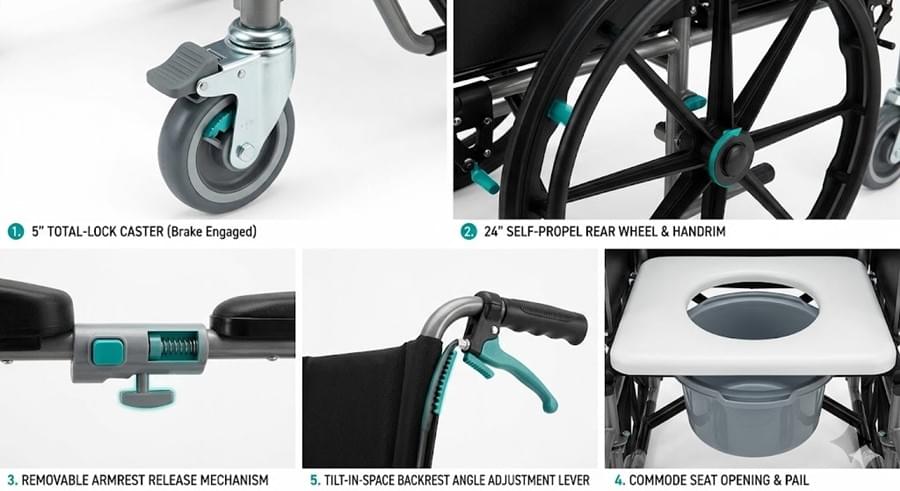
Spec profile: Weight capacity ≤ 150 kg. Aluminum frame (lightweight, corrosion-resistant). Seat width 18″–20″ standard. Removable armrests for lateral transfers. 5″ total-lock casters for caregiver push operation. Closed or commode seat, depending on ward needs.
Most common SKU in institutional fleet
⚖️ Bariatric Patients
Patients with a BMI > 35 or body weight exceeding 150 kg. Standard frames cannot safely support this load — structural failure under weight is a documented injury cause.
Spec profile: Weight capacity 180–272 kg. Carbon steel electroplated frame (higher load rating per our aluminum vs. steel comparison). Seat width 22″–24″ wide. Reinforced cross-bar under seat. Heavy-duty total-lock casters (5″ minimum). Commode opening with pail — bariatric patients nearly always require toileting support.
Fastest-growing segment in hospital procurement
🛏️ Dependent / Non-Ambulatory
Patients with minimal or no trunk control — severe stroke, spinal cord injury, advanced neurological conditions. These patients cannot maintain an upright posture independently and risk sliding forward during showering.
Spec profile: Commode opening seat (mandatory — eliminates transfer to separate toilet). Removable armrests for hoist/sling transfers. Swing-away or elevating footrests for access. Tilt-in-space or reclining backrest — patients without trunk control need posterior tilt to prevent forward sliding and redistribute pressure. This feature alone separates clinical-grade equipment from consumer-grade alternatives.
Tilt-in-space = clinical necessity, not luxury
These three profiles cover the vast majority of shower wheelchair weight capacity and functional requirements in institutional settings. If your facility serves mixed patient populations, specify at least two models — standard and high-dependency — rather than compromising on a single middle-ground unit.
03 Select by Facility Use Case
Different Buildings, Different Priorities
The same shower wheelchair performs differently depending on where it is used. Facility type determines which features are non-negotiable and which are nice-to-have.
🏥 Hospital (Acute Care)
High patient turnover. Every piece of equipment is shared across admissions. Infection control is the top priority — HAIs (Healthcare-Associated Infections) are a direct metric that procurement is evaluated on.
Must-have: Seamless PU or closed-cell cushion (no fabric seams where pathogens collect). Corrosion-proof frame that withstands hospital-grade chemical disinfectants (quaternary ammonium, sodium hypochlorite) without surface degradation. 5″ total-lock casters for rapid repositioning. Quick-release pail for fast turnaround between patients. No upholstered components — every surface must be wipeable in under 60 seconds.
🏠 Nursing Home / Long-Term Care
Lower turnover, higher average length of stay. Residents often use the same shower wheelchair for months or years in nursing homes. Durability and resident comfort outweigh rapid-turnaround concerns.
Must-have: Commode opening seat (long-stay residents nearly all require toileting support). Higher weight capacity across the fleet (average resident weight is increasing). Comfortable padded seat for extended sitting. Consistent model across the facility — standardized fleet means fewer spare parts to stock and simpler staff training. Bulk purchase tiered pricing for 20+ unit orders.
♿ Rehabilitation Center
Patient independence is the clinical goal. Equipment must support progressive mobilization — from full caregiver assistance toward self-propulsion as rehabilitation advances.
Must-have: 24″ self-propel rear wheels (patients can wheel themselves as strength returns). Adjustable-width frame (accommodates changing body composition during recovery). Removable armrests for transfer training. Lightweight aluminum frame — lighter weight makes self-propulsion realistic for recovering patients. Optional transit-style 4″ casters available for early-stage non-ambulatory use before transitioning to self-propel configuration.
For facilities with mixed missions — a rehabilitation wing inside a hospital, for example — specify a standard fleet for general wards plus a self-propel sub-fleet for rehab-specific use. The compliance documentation for both configurations should be available from the same supplier to simplify audit trails.
04 Five Specifications That Actually Matter
The Parameter Checklist for Your Next Purchase Order
Catalog pages list dozens of parameters. In practice, five specifications determine whether a shower commode wheelchair performs correctly in your facility — or becomes an expensive storage item.
| Specification | Standard | Bariatric / High-Dependency | Why It Matters |
|---|---|---|---|
| Weight Capacity | ≤ 150 kg | 180–272 kg | Structural failure under load = patient injury + liability |
| Seat Width | 18″–20″ | 22″–24″ | Too narrow = pressure points + skin breakdown; too wide = poor posture |
| Commode Opening | Optional (ward-dependent) | Mandatory | Eliminates second transfer to toilet — saves 8–12 min per patient per shift |
| Armrest & Footrest | Removable armrests; fixed footrests | Removable armrests; swing-away footrests | Enables lateral/hoist transfers without lifting the patient over barriers |
| Caster / Wheel Config | 4″–5″ total-lock casters | 5″ heavy-duty casters OR 24″ self-propel rear wheels | Casters = caregiver control (hospital/LTC); 24″ wheels = patient independence (rehab) |
Caster vs. 24″ wheel — the choice most buyers overlook. In hospitals and nursing homes, 90%+ of shower wheelchairs for hospitals orders specify small 4″–5″ total-lock casters. The reason is simple: full caregiver control in tight bathroom spaces, and the locking mechanism prevents any unintended movement during patient transfer. In rehabilitation centers, the opposite applies — 24″ self-propel rear wheels let patients build upper-body strength and independence as part of their recovery plan. Specifying the wrong wheel configuration is a functional mismatch, not a cosmetic one.
For material and compliance specifications, see our aluminum vs. steel shower wheelchair durability guide and shower wheelchair safety compliance guide.
05 Satcon Selection Support
Match the Model to the Mission — Not the Other Way Around
Satcon manufactures three shower commode wheelchair series, each engineered for a different patient profile and facility requirement. One supplier, one quality system, one compliance package — whether you need 10 units for a single ward or 200 for a hospital group rollout.
Standard Series
Aluminum frame, ≤ 150 kg capacity, 18″–20″ seat, removable armrests, 5″ total-lock casters. Hospital and nursing home general-purpose fleet. Available with a commode or closed seat.
Best seller for institutional fleet
Heavy-Duty / Bariatric Series
Carbon steel electroplated frame, 180–272 kg capacity, 22″–24″ wide seat, reinforced cross-bar, heavy-duty 5″ casters, commode opening with pail. Engineered for bariatric wards and high-weight patient populations.
272 kg max load — hospital-grade structural integrity
High-Dependency / Rehab Series
Aluminum frame with tilt-in-space or reclining backrest, commode opening, swing-away footrests, and removable armrests for hoist transfers. Available in self-propel (24″ rear wheels) or transit (5″ casters) configuration. Designed for dependent patients and rehabilitation progression.
Tilt-in-space + self-propel options
OEM & Customization: Seat width, weight capacity, armrest style, caster/wheel configuration, and frame finish can be specified to match your facility’s exact requirements. Technical drawings and photorealistic mockups were provided before production commitment.
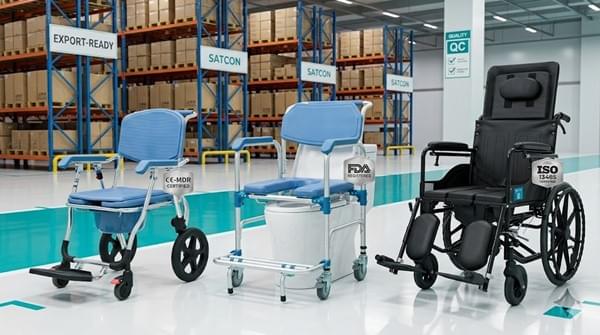
Compliance documents (CE-MDR DoC, FDA registration, ISO 13485/9001 certificates, third-party test reports) and tiered bulk pricing are available on request — no guessing, no surprises. All documentation matches the specifications you ordered.
Need Help Specifying the Right Model?
Tell us your patient profile and facility type. We’ll recommend the correct specification set, provide full compliance documentation, and send tiered bulk pricing — all before you commit to anything.
Frequently Asked Questions
What weight capacity do hospitals typically specify for shower wheelchairs?
Most hospitals specify a minimum of 150 kg for standard wards and 180–250 kg for bariatric units. The shower wheelchair weight capacity must exceed the heaviest patient in the target ward by a safe margin — typically 20% above the maximum expected patient weight. Specifying a 150 kg chair for a ward where patients regularly exceed 130 kg is a compliance risk.
Does a shower commode wheelchair need a commode opening seat?
It depends on the patient population. For shower wheelchair for nursing homes and long-term care, a commode opening is essentially mandatory — the majority of long-stay residents require toileting support, and a separate transfer to a commode doubles fall risk and nursing time. For acute care surgical wards where patients have short stays and retain toileting independence, a closed seat may be acceptable.
What is the difference between a shower chair and a shower commode wheelchair?
A shower chair is a lightweight, non-wheeled seating device placed inside a shower stall — the patient must walk or be transferred to it. A shower commode wheelchair has wheels (casters or self-propel), allows the patient to be wheeled directly into the shower area, and includes a commode opening with a pail for toileting. The wheelchair format eliminates multiple patient transfers per hygiene episode, which is why it is the standard specification for institutional care.
Can one shower wheelchair model serve all patient types in a facility?
Not effectively. A standard 150 kg model cannot safely serve bariatric patients, and a heavy-duty 272 kg steel model is unnecessarily heavy and wide for ambulatory patients. Best practice is a mixed fleet: standard models for general wards plus bariatric and/or high-dependency models for specialized units. A single shower commode wheelchair supplier who offers all three series simplifies procurement, compliance documentation, and spare parts management.