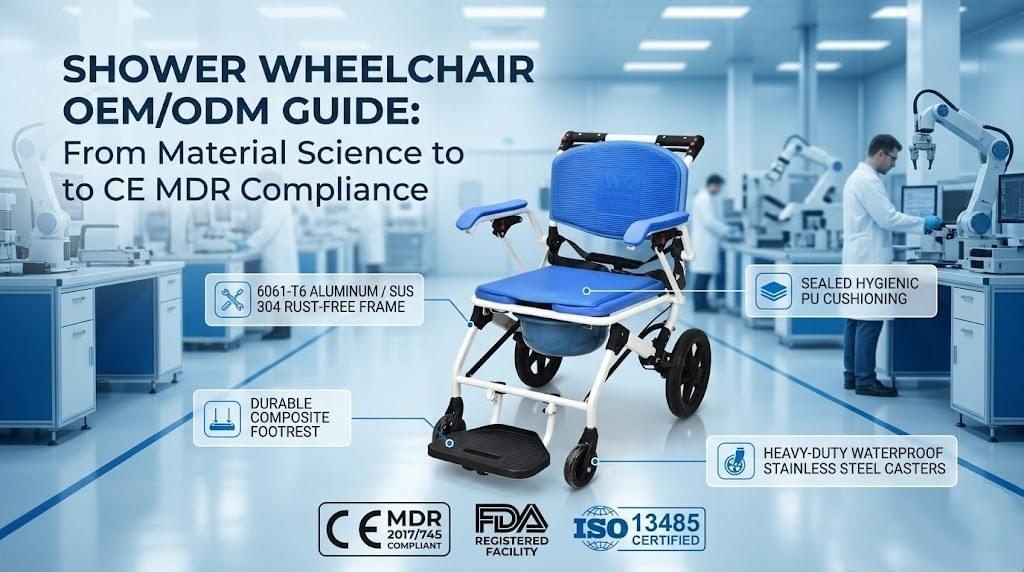
Updated for the EU MDR transition deadline. A comprehensive guide to shower wheelchair safety compliance — from CE-MDR Class I declaration and UDI barcode requirements to FDA registration and international testing standards. Plus: why non-compliant documentation risks customs seizure, VAT refund rejection, and financial audit failure.
shower wheelchair CE MDR compliance
shower commode chair FDA requirements
shower wheelchair supplier
01 Why Compliance Matters More Than Price
Why Shower Wheelchair Safety Compliance is Non-Negotiable in 2026
A shower wheelchair is not just mobility equipment — it is a medical device that operates in wet, high-risk environments with vulnerable patients every single day. When you source one without proper certification documentation, you are not saving money. You are transferring risk onto your facility’s customs team, finance department, and legal counsel. As covered in our Shower Wheelchair Procurement & Safety Guide, compliance is the foundation of any responsible procurement process.
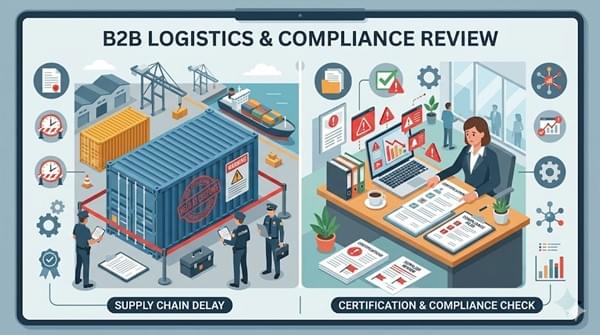
The consequences cascade in three layers. First layer: your shipment gets detained at customs or rejected at the receiving dock because the paperwork does not meet regulatory thresholds. Second layer: non-compliant documentation can trigger VAT refund rejections and financial audit failures — customs authorities require complete compliance proof before processing duty recovery claims, and your finance auditor will flag unverified suppliers as a control weakness. Third layer: if a patient suffers injury from an uncertified device, product liability claims land on your desk, not the factory’s.
The lowest-price quote often carries the highest hidden cost. A shower wheelchair supplier who provides complete, verifiable compliance documentation on day one is not more expensive — they just show you the real price upfront.
02 Regulatory Landscape
The Global Framework for Shower Wheelchair Safety Compliance: EU vs. US
The European Union and the United States regulate shower wheelchairs under different frameworks, different classifications, and different documentation requirements. Understanding both paths is essential if you source globally or serve customers across regions. The old MDD system in Europe has been fully replaced by MDR since 2024–2025 — any supplier still referencing “MDD compliant” is already outdated.
| Requirement | 🇪🇺 European Union (EU) | 🇺🇸 United States (USA) |
|---|---|---|
| Regulation | MDR (EU) 2017/745 — fully replaced MDD | FD&C Act + 21 CFR Part 880 |
| Classification | Class I Medical Device | Class I — manual models exempt from 510(k) |
| Certification Path | DoC self-declaration backed by TCF technical file | FDA Facility Registration + Device Listing |
| Mandatory Agent | EC-REP (EU Authorized Representative) | US Agent (US-based legal entity) |
| UDI Requirement | EUDAMED registration → SRN + UDI barcode mandatory on packaging | FDA UDI database entry → DI + PI assigned |
| Post-Market Surveillance | PMS plan + PSUR + incident reporting via EUDAMED | MedWatch adverse event reporting |
| Primary Test Standards | EN ISO 12182 / ISO 17966 | General safety standards (slip/corrosion/load) |
🇪🇺 Europe: The MDR Path
Confirm Class I classification → compile TCF technical file (risk management, clinical evaluation, PMS plan) → sign DoC declaration of conformity → appoint EC-REP → register in EUDAMED to obtain SRN + UDI → apply CE mark + UDI barcode to packaging → place on market. Old MDD declarations expired in 2024–2025 — any supplier offering “MDD certified” products is selling obsolete paperwork.
🇺🇸 USA: The FDA Path
Confirm Class I exemption from 510(k) for manual models → appoint US Agent → submit Facility Registration → complete Device Listing to get FDA registration number → enter UDI database (DI + PI) → comply with 21 CFR labeling and CGMP basics → sell. Electric or powered shower wheelchairs may require 510(k) clearance depending on design classification.
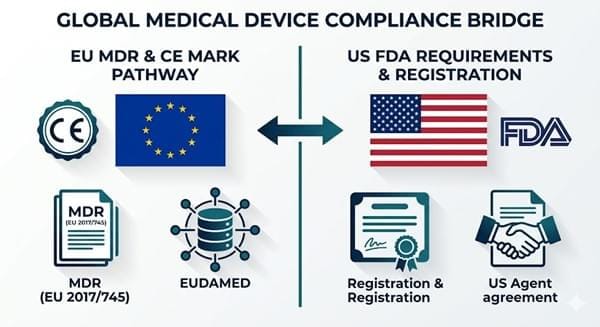
The critical takeaway: UDI (Unique Device Identification) is no longer optional in either market. Your supplier must generate scannable Data Matrix or QR barcodes following GS1/HIBCC encoding rules and print them on product packaging. If a supplier cannot produce a valid UDI file, their actual export experience is questionable — this requirement has been enforced worldwide since the early 2020s.
03 Testing Standards
Which ISO Standards Actually Apply to Shower Wheelchairs?
Here is a common mistake: assuming that ISO 7176 (the standard series for ordinary wheelchairs) automatically covers shower wheelchairs. It does not — or at least, not completely. ISO 7176 focuses on mobility performance for indoor/outdoor use at speeds up to 15 km/h. A shower wheelchair has a fundamentally different use case: stationary or short-distance use in wet environments where corrosion resistance, slip prevention, and skin-contact material safety matter far more than rolling dynamics.
| Test Category | Applicable Standard | Key Requirement |
|---|---|---|
| Static Load Capacity | ISO 17966 / EN ISO 12182 | ≥1.5× rated load without permanent deformation |
| Seat/Back Fatigue Strength | ISO 17966 | 100,000 simulated sitting cycles |
| Material Corrosion Resistance | EN ISO 12182 | 72-hour salt spray test or equivalent method |
| Slip Resistance | ISO 17966 | Friction coefficient ≥0.6 on seat surface and footrest |
| Edge Safety (sharp corners) | ISO 17966 | Corner radius ≥3mm on all user-contact edges |
| Biocompatibility (skin contact)* | ISO 10993-5 / -10* | Negative irritation/sensitization result* |
The two standards that matter most:
ISO 17966 is the dedicated international standard for personal hygiene assistive products — bathing, washing, and toileting devices. This is the authoritative reference specifically written for shower wheelchairs.
EN ISO 12182 covers general requirements and test methods for all assistive products for persons with disability. It provides the foundational layer of static load, material safety, and documentation compliance.
ISO 7176 still has limited relevance if your shower wheelchair model also functions as a self-propelled mobility device with large rear wheels — in that case, ISO 7176-19 (dynamic stability) and ISO 7176-14 (seat strength) may be partially referenced. But for the majority of institutional shower commode chairs used within bathroom enclosures, ISO 17966 and EN ISO 12182 are the correct test framework. Any qualified shower wheelchair supplier should be able to produce third-party test reports against these specific standards — not a generic “wheelchair test certificate.”
04 Quality Management Systems
Why ISO 13485 Is the Buyer’s Most Powerful Filter — Even When It Is Not Mandatory
Here is an important distinction: under both EU MDR and US FDA regulations, Class I shower wheelchairs are not legally required to hold ISO 13485 certification. The regulation allows manufacturers to demonstrate conformity through other means. But in actual procurement practice across Europe and North America, ISO 13485 has become the de facto gatekeeper between professional factories and unverified workshops.
What ISO 13485 Actually Proves
It demonstrates that the factory operates a documented quality management system designed specifically for medical devices — covering design controls, supplier management, process validation, traceability from raw materials to finished goods, CAPA (corrective and preventive action) protocols, and annual surveillance audits. It means problems get fixed systematically, not by word-of-mouth.
What Happens Without It
Suppliers without ISO 13485 can still export technically, but they get filtered out at the distributor and hospital procurement level. Major buying groups list it as a mandatory requirement in their RFP templates. Government tenders in most EU member states award extra points or outright require QMS certification. In practical terms, no ISO 13485 = access to roughly half your potential customer base disappears.
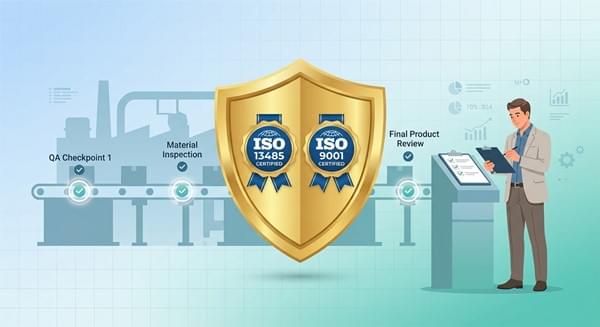
ISO 9001 is the baseline — virtually every export-oriented factory holds it. ISO 13485 is the upgrade that signals medical-device-grade process control. Satcon maintains active ISO 13485:2016 certification alongside ISO 9001:2015, with clean audit records and zero open major non-conformances. When you request QMS credentials from a shower wheelchair supplier, check two things: the certificate validity date (no expired documents), and whether the company name on the certificate matches your contractual counterparty.
05 Procurement Checklist
Procurement Checklist for Shower Wheelchair Safety Compliance
Stop taking verbal assurances. Run through these four checkpoints before committing to any order. Each one maps directly to a real failure mode we have seen in the market.
1️⃣ Show Me the Original Documents
CE DoC original (with signatory name and date). FDA Registration Certificate screenshot (verifiable online). Third-party test reports — not internal inspection records — issued by a CNAS or ILAC-MRA accredited lab. UDI assignment file and barcode artwork. TCF technical file index page proving the complete documentation package exists.
2️⃣ Who Are Your Agents?
EC-REP authorization letter with full name, EU address, and valid date range. US Agent appointment confirmation proving the agent is a US-registered legal entity (not a trading company using a maildrop). Both agents must be able to respond to regulatory inquiries within 48 hours.
3️⃣ Can I Verify Your Test Reports?
Laboratory accreditation certificate (CNAS/ILAC-MRA) — checkable on the lab’s official website. The report number must cross-reference to your specific production batch number. Test result must say “PASS” — not “acceptable,” “meets expectation,” or any hedged language.
4️⃣ Show Me Your QMS Certificate
ISO 13485 and/or ISO 9001 original certificate with current validity. The latest surveillance audit summary shows no unresolved major non-conformances. The company name on the certificate must match the entity you are contracting with — no name mismatches allowed.
⚠️ Four Red Flags That Should Stop You Immediately
🚩 “We are still applying for it.” Compliance certification must be complete before shipment. “In progress” means “we do not have it.” Never accept pending certifications as a delivery condition.
🚩 Generic-looking certificates from unknown bodies. If a “CE compliance certificate” looks official but has no Notified Body (NB) number and the supplier cannot produce the underlying TCF technical file, it is likely a broker-issued document with no legal standing. Real CE DoCs list manufacturer details, EC-REP info, and applicable standards explicitly.
🚩 Test reports only in Chinese. International markets require English-language originals. Pure Chinese reports signal that the supplier’s actual export experience does not match their claimed target markets.
🚩 UDI? What’s that? If a supplier cannot explain UDI barcode generation, GS1 encoding rules, or Data Matrix printing requirements, their hands-on export experience since the early 2020s is questionable. UDI enforcement is non-negotiable in both the EU and the US markets today.
06 Satcom Compliance Position
Satcon Shower Wheelchairs: Full Documentation, Zero Guesswork
Satcon manufactures shower wheelchairs for both European and American markets — because our customers operate across both regions. We do not recommend based on which option carries a higher margin; we recommend based on what your target market actually requires.
✅ CE-MDR Class I Compliant (Europe)
Complete the TCF technical file package under controlled revision. Valid DoC of Conformity with full standard reference list. Appointed EC-REP with active authorization. EUDAMED registered — SRN obtained, UDI assigned. Product packaging includes a mandatory Data Matrix UDI barcode. All shower wheelchair models are covered under the current MDR framework.
MDR-compliant, not legacy MDD
✅ FDA Registered (USA)
Facility Registration completed (verifiable online). All series listed via Device Listing. US Agent appointed and current. Manual models fully compliant via Class I exemption pathway — no 510(k) required. FDA UDI database entry completed (DI + PI assigned). For electric model requirements, we support 510(k) submission assistance as needed.
Manual models are exempt from 510(k)
✅ Quality Systems Certified
ISO 13485:2016 active (medical device-specific QMS) plus ISO 9001:2015. Clean surveillance audit record with zero major open NCs. Third-party testing partners hold CNAS/ILAC-MRA accreditation. For OEM clients: technical file translation, DoC template adaptation, UDI barcode generation support, and EC-REP / US Agent coordination are available.
Mixed-material orders (aluminum standard fleet + steel heavy-duty units) and mixed-certification orders (EU + US destination in one container) are standard practice at Satcon. One supplier, one quality system, one set of compliance documents covering every unit you order.
Need Full Compliance Documentation Before You Order?
Tell us your target market (EU / US / both). We’ll email you complete CE DoC, FDA certificates, test reports, UDI credentials, and QMS certifications — all before you commit to anything.
Frequently Asked Questions
Does a shower wheelchair need CE certification?
Yes. To enter the European market, a shower wheelchair falls under MDR (EU) 2017/745 as a Class I medical device, requiring CE marking and a Declaration of Conformity (DoC). The required steps: compile TCF technical file → sign DoC → appoint an authorized representative (EC-REP) → register in EUDAMED to obtain SRN + UDI → apply CE mark and UDI barcode to packaging. Important note: the old MDD framework was fully replaced by MDR between 2024 and 2025. Any supplier still offering “MDD compliant” documentation is providing outdated paperwork that may no longer be accepted by customs authorities.
Is an FDA 510(k) required for shower commode chairs?
Not for manual models. Manual shower wheelchairs and commode chairs are classified by the FDA as Class I devices exempt from 510(k) premarket notification. The requirements are simpler but still mandatory: (1) Facility Registration with the FDA, (2) Device Listing for each product model, (3) appointment of a US Agent, and (4) compliance with 21 CFR general safety and labeling requirements. Electric or powered shower wheelchairs may require 510(k) clearance depending on whether their design exceeds Class I exemption limits.
What ISO standards apply to shower wheelchairs?
The most authoritative dedicated standard is ISO 17966 (Assistive products for persons with disability — Bathing, washing, and toileting assistive products). This is the international standard specifically written for shower wheelchairs. Second priority is EN ISO 12182 (general requirements and test methods for assistive products), which covers foundational static load, material safety, and documentation compliance. ISO 7176 only applies partially when the product also functions as a self-propelled mobility device (large rear wheels for independent movement). Additionally, professional buyers increasingly check for ISO 10993 (biocompatibility — skin irritation and sensitization testing for user-contact components) and, for electric models, IPX4/IPX6 waterproof rating per IEC 60529.
Can a supplier without ISO 13485 still export to the EU?
Technically, yes — EU MDR regulations do not mandate ISO 13485 for Class I devices, so a supplier without this certificate can legally ship compliant products. But in real-world procurement, most legitimate distributors, hospital groups, and government tender processes list ISO 13485 as a mandatory supplier qualification criterion. Without it, access to roughly half of your potential B2B customer base disappears. The real value of ISO 13485 is not regulatory compulsion — it is proof that the factory operates medical-device-grade process controls, documented traceability, and annual third-party audits. It separates professional manufacturers from workshops that cut corners on quality systems.