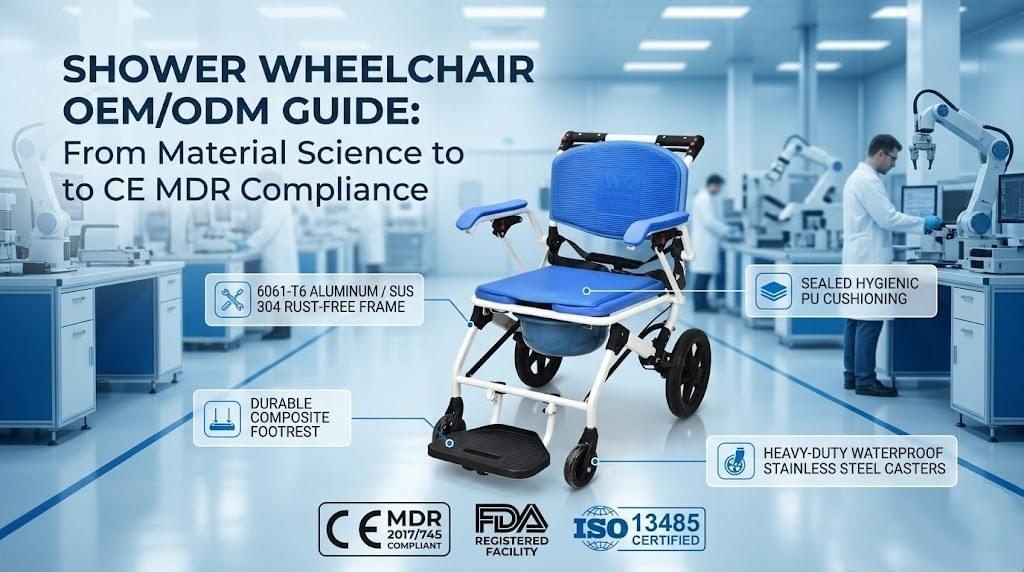
OEM is not logo printing. It is the alignment of mechanical engineering, anti-corrosion durability, and international regulatory transfer under your brand name. This guide covers how a qualified shower wheelchair OEM manufacturer delivers private label, white label, and ODM solutions with full CE/FDA compliance documentation support.
Private Label
CE Certified
Global demand for bathroom mobility equipment OEM supplier partnerships has accelerated over five years — driven by aging demographics in Europe/North America, home healthcare expansion in Southeast Asia, and government rehabilitation programs across the Middle East/Latin America. Distributors, once competing on generic pricing, now shift toward OEM to protect margins, differentiate product lines, and control regulatory documentation. This guide explains what shower wheelchair OEM manufacturer cooperation involves, which model fits your business stage, what specs can be customized, how CE/FDA certifications transfer, and how to evaluate factory partners in China remotely.
01 Strategic Advantages
Why Tier-1 Distributors Choose Custom OEM Over Off-the-Shelf Procurement
Most importers start with wholesale models. As competition intensifies on B2B platforms and tender portals, buyers return asking for something different — their own brand, local spec requirements, and products competitors cannot directly price-match.
🛡️ Margin Protection & Pricing Autonomy
Generic spot items create price wars on Amazon, pharmacy systems, and tender portals. A wholesale shower wheelchair manufacturer supporting OEM lets you build exclusive SKUs, preventing direct comparison. Private label typically commands 15–35% higher retail than identical unbranded units.
📋 Clinical Differentiation for Regional Tenders
Public tenders specify exact parameters: seat width ±5 mm, weight capacity (150/200/272 kg), caster brake config, and clearance heights matched to local toilet fixtures. An OEM partner engineers these into your branded model — no off-the-shelf unit can guarantee it.
📄 Regulatory Ownership & IP Security
Sourcing via a trading company means technical files belong to someone else — if they exist, your registration becomes orphaned. Working directly with a CE-certified shower wheelchair manufacturer lets you establish your brand as Legal Manufacturer or Authorized Rep with documentation you control.
⚙️ Long-Term Supply Chain Stability
Professional OEM factories maintain controlled sourcing, documented QC at every stage, spare parts continuity spanning 5+ years, and production planning for seasonal spikes. Trading intermediaries lack this visibility — and cannot fix disruptions when they occur.
These four advantages explain why distributors graduate from wholesale to structured shower wheelchair OEM manufacturer partnerships. The question is which model matches your scale.
02 Collaboration Models
Private Label vs. White Label vs. ODM: What Changes Under Each Model
Medical device OEM is a spectrum of collaboration depth. Understanding where each model sits on IP ownership, tooling investment, time-to-market, and regulatory responsibility determines which path fits today and scales tomorrow.
| Metric | White Label | Private Label | ODM |
|---|---|---|---|
| IP / Design Ownership | The factory owns all | The factory owns design; Brand owns logo/packaging | Shared or exclusive |
| Tooling Investment | $0 (existing) | $0 (standard + color/logo) | High (custom molds) |
| Time-to-Market | 2–3 weeks | 4–6 weeks | 4–6 months |
| Typical MOQ | 20–50 units | 100–200 units | 500+ / FCL |
| Regulatory Risk File | Tied to the factory | TF transfer required | New TF submission |
| Best For | New entrants | Established brands scaling | Large chains/gov projects |
📦 White Label
Pre-designed factory model sold to multiple buyers. Same physical product as others — only the carton may carry your brand.
You get: Logo on carton, manual rebranding, stock colors from existing options.
Limit: Limited exclusivity. Lower differentiation ceiling.
Lowest barrier · Fastest delivery
🏷️ Private Label
Most common shower commode chair private label supplier model. Customize visible branding while leveraging a proven engineering platform.
Customizable: Laser-engraved logo, Pantone powder coat, custom carton, multilingual manuals, cushion color, and accessories.
Edge: Stronger identity than WL. Moderate MOQ. Proven platform reduces risk.
Most popular for medical brands
⚙️ ODM
Full product engineering partnership. Factory designs/manufactures new or significantly modified products exclusively for your brand.
May include: New frame geometry, foldable redesigns, pediatric/bariatric versions, tool-free assembly, lightweight upgrades, proprietary PU seating, and custom plastic molds.
For: National distributors, medical brands, hospital groups, gov rehab projects.
Highest diff · Longest payoff
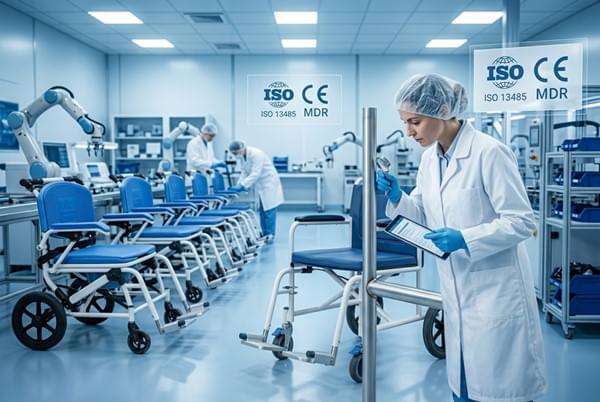
Most relationships start at White Label/Private Label and progress to ODM as volume grows. For material details, see our aluminum vs. steel durability guide and CE/FDA compliance guide.
03 Customization Framework
Component-Level Customization Architecture for Waterproof Mobility Equipment
Many first-time buyers underestimate how deep modern shower wheelchair ODM customization service capabilities go. Four layers below — each affects cost, lead time, and clinical performance.
🔩 Frame Material & Engineering
- 6061-T6 Aluminum — anodized/powder-coated. Wall ≥ 1.2 mm. Net weight 8–12 kg/unit. European market preference.
- SUS 304 Stainless steel — electroplated/chrome. Wall ≥ 2.0 mm bariatric. Max corrosion resistance for humid regions.
- Carbon steel Q235 — powder-coated. Economical. Requires salt-spray verification (ASTM B117 ≥ 96 hrs).
Pantone matching available. Anti-corrosion coating passes ≥ 96 hours salt-spray testing.
💺 Seating & Ergonomics
- High-density PU foam — waterproof seamless surface. Density 45–65 kg/m³ per patient profile.
- Antibacterial quick-dry mesh — removable, machine-washable. Required for infection-control facilities.
- Commode cutout seat — front/rear/full-open configs. Edge radius prevents skin shear during transfers.
Optional: drainage slots, lumbar insert, pressure-redistribution gel overlay.
🛞 Hardware, Casters & Braking
- 4″–5″ total-lock casters — dual-brake (swivel + wheel). Stainless bearing housing. Closed-loop linkage for wet-room exposure.
- 6″–8″ heavy-duty casters — bariatric 200–272 kg. Reinforced fork + double-bearing race.
- 24″ self-propel rear wheels — ergonomic handrims. Aluminum rim or stainless spoke options.
All casters tested ≥ 10,000 braking cycles under full load.
📦 Packaging & Branding
- ISTA-2B drop-test certified cartons — survive international freight multi-drop chains.
- Multilingual manuals — EN/ES/AR/FR/DE templates for translation.
- Laser-etched compliance labels — CE mark, UDI barcode area, manufacturer address, batch traceability.
- Pallet labeling — HS code, count, weights, port marks. Container loading optimization available.
Logo methods: silk-screen, laser engraving, molded plates, and metal badge riveting.
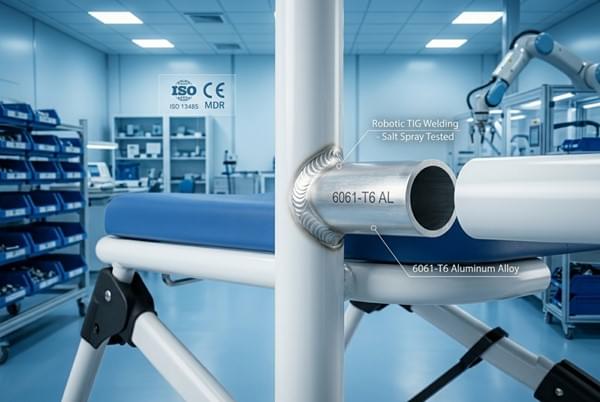
OEM customization must match the user’s clinical needs to ensure safety. For matching seat dimensions and cushion densities with different patient disability levels, check our clinical selection matrix.
Our use of robotic TIG welding and premium materials directly impacts clinical safety. For a deeper breakdown of structural safety standards and what hospital procurement managers must look for, check out our comprehensive Shower Wheelchair Supplier Procurement & Safety Guide.
04 Process & Compliance
Step-by-Step OEM Workflow & Regulatory Compliance Transfer Explained
Understanding the actual workflow reduces surprises and clarifies when compliance documents change hands. Every reputable custom shower wheelchair factory in China follows a version of this — the difference is communication transparency.
1
RFQ Analysis & Feasibility Confirmation
Submit target market region, intended standards (CE MDR / FDA / ANVISA), price band, estimated annual volume, and must-have specs. Factory engineering reviews against existing lines and flags non-standard requirements. Response: typically 3–5 working days.
2
Quotation & MOQ Agreement
MOQ depends on customization depth:
- White Label: 20–50 units/SKU
- Private Label: 100–200 units/model
- Semi-Custom OEM: 100–300 units
- Full ODM Development: 500+ units or FCL
3
Prototype & Sample Validation
Factory produces physical sample(s): finished unit, packaging mockup with branding, and custom accessories. Evaluation checklist: waterproof performance (spray/immersion), static load test (1.5× rated capacity), dynamic load validation, corrosion resistance (salt-spray/humidity chamber), folding cycle test (≥ 5,000 open/close cycles), caster brake function verification. Sample approval triggers mass production.
4
Compliance Documentation & Certificate Transfer ⭐
This step creates the most customs detention risk if mishandled for a CE-certified shower wheelchair manufacturer:
🇪🇺 EU Market (CE MDR 2017/745)
Under CE MDR 2017/745, traditional OBL is obsolete. We offer two compliant pathways to secure EU customs clearance and seamless EUDAMED integration:
- Legal Manufacturer Route (Full TD Access): For brands registering as the Legal Manufacturer with their own SRN. We facilitate Technical Documentation (TD) sharing and sign formal Quality Assurance Agreements (QAA) to support your Notified Body conformity assessment.
- Importer/Distributor Route (MDR Article 16): Satcon Medical remains the Legal Manufacturer, owning the CE file, clinical evaluation, and post-market surveillance. Your brand operates as the official Importer/Distributor under Article 16 guidelines, scaling brand equity without the regulatory liability.
US Market (FDA): Class I (manual) or Class II (power) classification. For OEM arrangements:
- FDA Contract Manufacturer Listing — OEM factory lists itself as a Contract Manufacturer under your establishment registration (FEI). Your brand holds device listing and 510(k)/exempt status. Fully compliant, widely used by US medical device importers.
Bottom line: certifications belong to the manufacturing entity, but authorized OEM labeling support, complete Technical File packages, and registration assistance are standard deliverables from any professional medical device white-label manufacturer in China. Verify before committing.
5
Mass Production & Quality Control
Professional OEM QC at multiple stages: incoming raw material verification (alloy certs, tube wall gauging), welding seam inspection, assembly-line functional checks (brake engagement, caster swivel, folding latch retention), completed-unit static load sampling, pre-packaging cosmetic audit. Target defect rates: ≤ 1.5% minor, ≤ 0.3% critical.
6
Shipping, Documentation & After-Sales Support
Final package: commercial invoice, packing list, B/L, Certificate of Origin (if requested), CE DoC copy, ISO 13485 certificate, test report summary, warranty terms. After-sales: spare parts availability (casters, brakes, cushions, footrests) with guaranteed supply window (typically 5–7 years post-discontinuation), barcode/UDI coordination, and technical troubleshooting forwarded through your channel.
Lead Time Summary: Standard PL = 35–45 days (first run) | Repeat orders = 25–30 days | Full ODM = 4–6 months
Buyer Pitfalls
Common OEM Procurement Mistakes That Cost Importers Money & Reputation
❌ Price-Only Selection
Lowest FOB often omits compliance docs, uses thinner-gauge materials, or comes from a reseller with no factory access.
❌ Ignoring Corrosion Testing
No ASTM B117 salt-spray report showing ≥ 96 hours = rust complaints within 6–12 months of deployment.
❌ No Spare Parts Confirmation
A broken caster shouldn’t require replacing the whole unit. Confirm OEM stocks individual parts with supply commitment.
❌ Skipping Compliance Verification
“Factory has CE, so we’re fine” = #1 cause of EU customs detentions for OEM shipments.
❌ No Packaging Drop-Test
No ISTA-2B validation = damaged-in-transit claims eating margin on first shipment.
05 Satcon Manufacturing
Satcon: Direct Factory, Not a Trading Company
Satcon Medical operates its own production facility in Beijing, China, not an intermediary reselling other factories’ output under markup. This affects documentation authenticity, pricing transparency, QC access, and after-sales response time in ways that become obvious after the first order ships.
🏭 Factory vs. Trading Company: What Actually Changes
| Factor | Trading Company | Direct Factory (Satcon) |
|---|---|---|
| QC Access | Cannot show floor | Full visibility + video |
| Compliance Docs | Unknown source | Ours, verifiable online |
| Price Layer | Factory + trader markup | Ex-factory direct |
| Problem Resolution | Relies on 3rd party | We fix it on the floor |
| Spare Parts | No inventory control | In-house warehouse |
🏭 Production Infrastructure
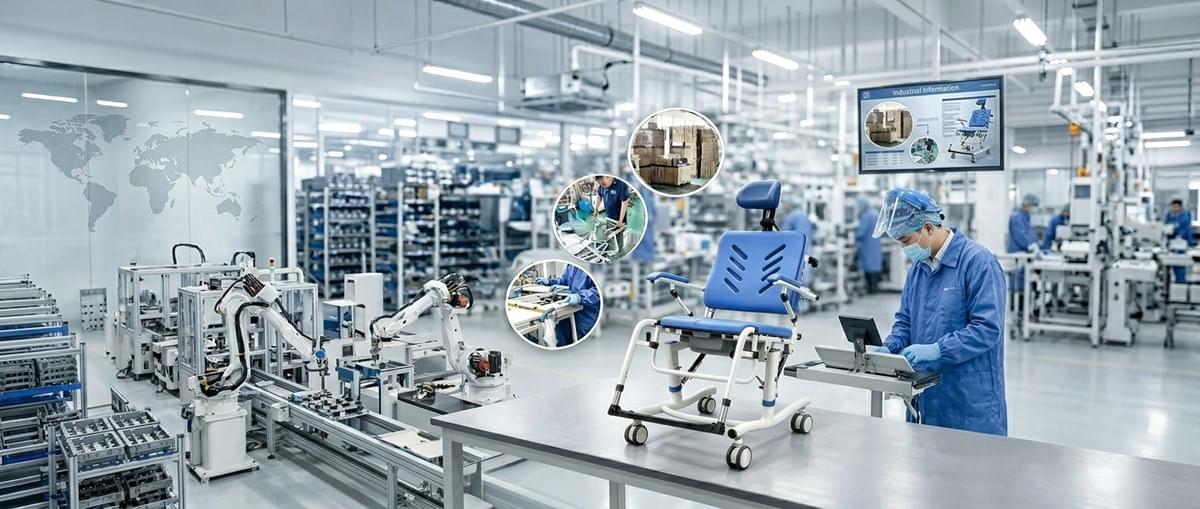
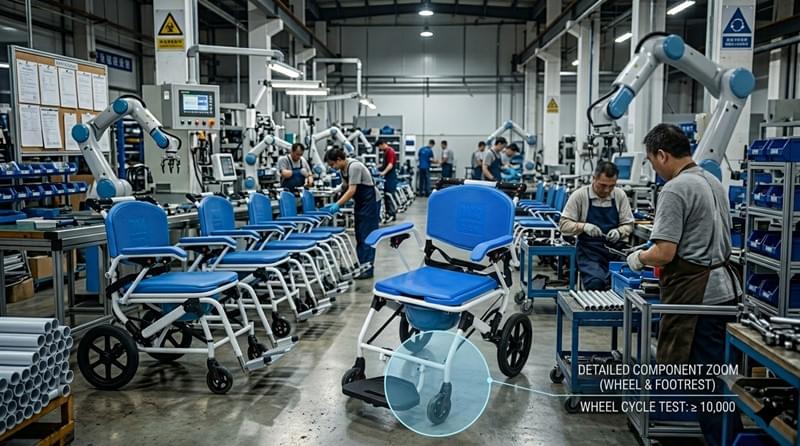
Dedicated shower wheelchair/commode chair assembly lines with automated welding for consistent joints. Independent QA lab with load-testing rig, salt-spray chamber, and folding-cycle bench. Incoming raw material inspection verifying alloy certificates per batch.
🌐 Global Export Record
Exported to 40+ countries: Europe, the Middle East, Southeast Asia, South America, and Africa. Active FDA registration maintained. CE filings are currently under MDR 2017/745. ISO 13485:2016 certified with continuous third-party surveillance audit passes since initial certification.
📐 OEM Service Scope
Private label / White Label / ODM. Custom frame geometry and material spec. Pantone color matching and laser logo engraving. ISTA-certified packaging design. Multilingual manual templates. Compliance doc support (CE DoC, FDA Contract Mfr Listing, ISO 13485 records)—photorealistic mockups before production commitment.
💰 Tiered Pricing & Shipping Terms
Volume tiers optimize per-unit cost: trial orders (10–50 units) at standard rates, mid-volume (100–500) qualify for tiered discounts, container-scale orders achieve the lowest landed cost through optimized pallet loading. Incoterms supported: FOB Tianjin/Xingang (most common), CIF, and DDP for turnkey logistics buyers.
🛡️ CE Certified (MDR 2017/745) · FDA Registered Facility · ISO 13485:2016 Certified · 40+ Countries Exported · OEM Catalog & Sample Policy Available on Request
Ready to explore OEM possibilities? Contact us with target market, volume estimate, and customization requirements — we’ll respond within 48 hours with a feasibility assessment and MOQ quotation.
Looking for a Shower Wheelchair OEM Partner Who Owns Their Factory?
Send us your target market, annual volume estimate, and customization wishlist. We’ll review feasibility, provide MOQ-specific pricing, outline compliance transfer options for your region, and ship physical samples — before any financial commitment.
WhatsApp: +86 13171713208 · Email: wheelchair@satconmed.com
Frequently Asked Questions
What is the minimum order quantity (MOQ) for a custom shower wheelchair OEM order?
MOQ depends on customization complexity. Standard Private Label (existing model + carton/manual rebranding) starts from 100 units per model. Semi-custom OEM (modified frame color, logo, packaging, accessory mix): 100–300 units. Full ODM development requiring new extrusion profiles or proprietary plastic molds typically requires 500+ units or a single 20ft Full Container Load to amortize tooling and engineering setup costs.
Can CE/FDA certifications be transferred with a private label product?
Yes. Under EU MDR 2017/745, you can register as the Legal Manufacturer by leveraging our technical file as compliance backup. As a fully CE certified shower wheelchair manufacturer, we provide complete documentation to support your EU registration. For the US market, we support FDA Contract Manufacturer Listing, where your establishment owns the device listing while our factory is listed as the Contract Manufacturer under your FEI. This streamlined, fully compliant pathway is widely utilized by international medical device importers working with a professional CE certified shower wheelchair manufacturer like us to secure market access quickly.
How long does the OEM customization process take from design to delivery?
Standard Private Label first production run: 35–45 days (includes physical proofing and sign-off of custom packaging and branding). Repeat orders typically compress to 25–30 days. Complex ODM projects requiring new mechanical molds or structural revisions: 4 to 6 months to accommodate engineering design, physical tooling fabrication, prototype validation, internal safety verification, and compliance filing before mass production begins. Timelines vary by order volume and customization scope — always confirm in writing during the RFQ stage.
What is the difference between white label and private label for medical devices?
White-label medical devices are generic, standard products where multiple distributors sell the identical design under different names, changing only the outer packaging.
In contrast, a shower wheelchair private label OEM project grants your brand exclusive rights to a customized version. It allows you to modify the product with unique configurations—such as custom medical-grade colors, upgraded waterproof cushion densities, or proprietary accessories. This shower wheelchair private label OEM model protects your business from direct market price comparison and builds significantly stronger distributor-customer loyalty than white labeling can achieve.