From material selection to compliance verification: a complete procurement framework for healthcare facilities evaluating a shower wheelchair supplier. Covers aluminum vs. steel durability, CE/FDA/ISO certification, clinical application mapping, and 5-year TCO modeling. Built on 10+ years of manufacturer data from 30+ countries.
Shower Wheelchair Procurement: Why the Wrong Choice Costs 3× More Over 5 Years
Most procurement decisions for shower wheelchairs are driven by unit price alone. But in wet, high-use healthcare environments, the cheapest wheelchair to buy is almost never the cheapest to own. Corrosion, part failure, and premature replacement drive the real cost — and the difference between a well-specified unit and a budget one compounds dramatically over time.
The numbers above describe averages. The real-world consequences are more direct. Frame corrosion in a shower wheelchair is not merely a cosmetic issue — it is a structural failure chain. A corroded tubular joint weakens under load; weakened joints cause brake-mounting failure; brake failure on a wet tile floor is a falls event. For any healthcare facility, a single patient fall incident carries a liability exposure that can reach 20 to 50 times the unit price of the wheelchair that failed. The math makes specification quality a risk management question, not a cost-saving question.
To put it in fleet terms: a 100-unit aluminum shower wheelchair fleet (purchase cost approximately $15,000–$22,000) with proper maintenance generates roughly $5,000–$6,000 in parts and service over five years, with an ~8% annual replacement rate totalling around $6,000–$8,800 in replacements. Five-year total: approximately $26,000–$37,000. The equivalent fleet in chrome-plated carbon steel, replacing units every 18–24 months, runs $48,000–$72,000 over the same period. The savings you see on the purchase order disappear within 18 months.
For any hospital or distributor evaluating a shower wheelchair supplier, the critical metric is not purchase price — it is total cost of ownership per year of service. → For the full material durability analysis with corrosion mechanics and lifespan data, see our Aluminum vs. Steel Shower Wheelchair Frame Guide.
5-Stage Shower Wheelchair Procurement Decision Framework
Successful hospital shower chair procurement follows a structured evaluation process. Skipping any stage leads to costly specification mismatches, compliance gaps, or supplier lock-in. Here is the framework used by procurement teams across 30+ countries:
Stage 01 — Needs Assessment
Before opening any product catalog, define three parameters: maximum patient body weight (bariatric thresholds at 130 kg and 180 kg matter for frame specification), daily usage cycles per unit (a nursing home chair used 4× per day wears faster than a hospital chair used once), and environmental humidity rating (shower room vs. bathroom-adjacent use). Facilities that skip this step routinely discover their specified model is under-rated for their heaviest patients, or over-engineered for a dry-storage application — both are procurement failures.
Stage 02 — Material Specification
Frame material selection is non-negotiable: aluminum alloy for all wet-zone deployments (shower rooms, wet bathrooms, poolside); powder-coated carbon steel only for dry-zone or budget-constrained settings where the unit will not be exposed to standing water. Chrome-plated steel must not be specified for any shower application — its coating lifespan under regular hospital disinfectant exposure is 12–18 months regardless of purchase price.
Stage 03 — Compliance Verification
Request model-specific documentation — not a factory-level certificate. A CE Declaration of Conformity must name the specific product model and reference the applicable standard (EN 12184 or ISO 7176 series). A generic “CE factory certificate” covering hundreds of product lines is not legally meaningful for EU import clearance. For U.S. buyers, verify the supplier’s FDA Establishment Registration is in Active status and that the specific model appears in their Device Listing — both are publicly searchable on the FDA website. → For a full regional compliance breakdown with 2026 MDR updates, see our Shower Wheelchair Safety Compliance Guide.
Stage 04 — Sample Testing
Order 2–3 sample units before bulk commitment. Test under actual facility conditions: wet-floor brake performance (locking distance on wet ceramic tile), weight loading at 110% of rated capacity, water submersion of caster assemblies for 72 hours, and chemical disinfectant exposure using your facility’s standard cleaning product. No serious supplier refuses a sample order. If they do, that refusal is itself the answer to your supplier evaluation question.
Stage 05 — Supplier Evaluation
Evaluate five dimensions beyond product quality: manufacturing capacity and lead time commitment (can they fulfill a 200-unit reorder in 30 days?), spare parts availability and shipping speed, after-sales technical response time, OEM customization capability, and the quality management system underlying production. A shower wheelchair supplier operating under ISO 13485 has a documented, auditable process — one that is not is managing quality informally, which means inconsistently.
Aluminum vs. Carbon Steel vs. Chrome Steel: Which Frame Survives Bathroom Conditions?
Frame material is the single most important specification for any aluminum shower wheelchair deployed in wet healthcare environments. The wrong choice does not just cost money — it compromises patient safety when corroded frames fail structural integrity tests. Understanding the failure mechanism is essential to making the right specification decision.
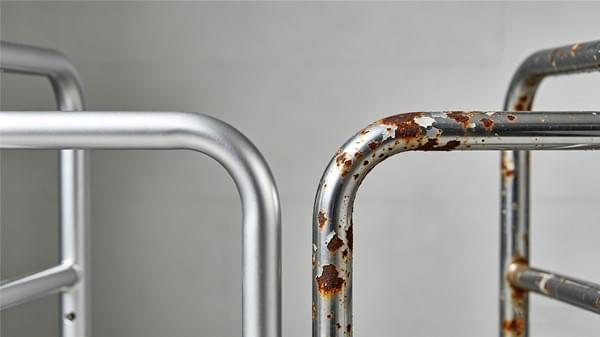
Chrome-plated steel fails in bathrooms for a predictable physical reason. The chrome layer applied to hospital-grade shower chairs is typically 0.01–0.03 mm thick. In a healthcare bathroom, this layer faces a compound attack: moisture, heat cycling, and — critically — institutional disinfectants. Hospital cleaning protocols routinely involve chlorine-based products (Virex, sodium hypochlorite solutions) and quaternary ammonium compounds. These chemicals accelerate micro-crack propagation through the chrome layer. Once the substrate is exposed, iron oxidation begins immediately. The visible rust you find within 12–18 months of deployment is not a quality defect you missed at inspection — it is the predictable outcome of specifying the wrong material for the environment.
Carbon steel with powder-coat finish performs better, but carries the same fundamental vulnerability: any coating breach — a scratch from a transfer board, a nick from a caster collision — exposes bare steel to the same corrosive environment. Carbon steel’s genuine advantage is load-bearing strength; it is the correct specification for high-weight-capacity dry-zone equipment. It is not the correct specification for shower rooms.
Aluminum alloy differs structurally. When the aluminum surface is scratched or damaged, it does not begin rusting. Instead, exposed aluminum reacts with oxygen and moisture to form a new aluminum oxide (Al₂O₃) layer — a self-repairing passivation film that seals the surface. This is not a coating. It is a metallurgical property. Furthermore, aluminum is chemically inert to the institutional disinfectants commonly used in healthcare — chlorine-based solutions, alcohol, and quaternary ammonium compounds leave the aluminum surface unaffected. This is why aluminum is the engineering standard for wet healthcare equipment, not a premium upgrade option.
The engineering conclusion is unambiguous: aluminum alloy delivers the lowest 5-year total cost of ownership in any wet environment. This is why Satcon’s entire shower wheelchair line uses aluminum construction as standard. → For the full technical breakdown including salt-spray test data and coating failure mechanisms, see our Aluminum vs. Steel Shower Wheelchair Durability Analysis.
Shower Wheelchair Application Matrix: Matching Models to Clinical Scenarios
Not every shower wheelchair fits every clinical setting. Patient acuity, caregiver ratios, infection control requirements, and facility infrastructure all determine the optimal specification. Here is how experienced facility managers match models to real-world scenarios:
Hospital Wards & ICU
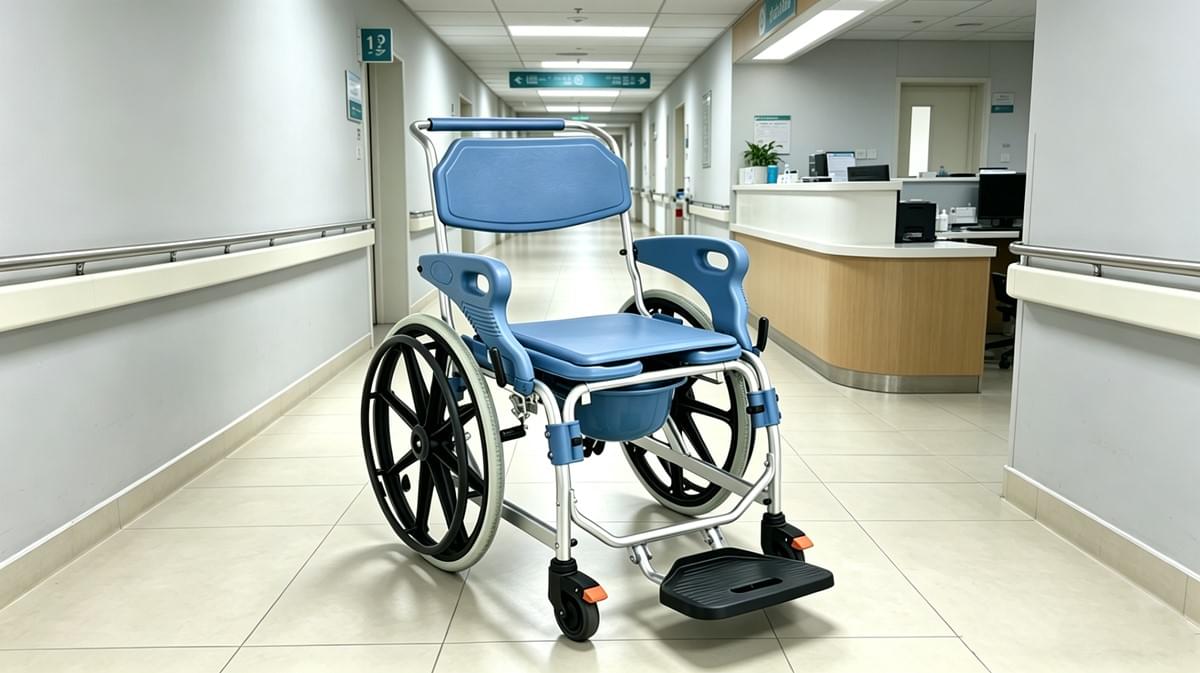
Hospital infection control committees are increasingly setting the terms of shower wheelchair procurement — not the equipment managers. Their primary concerns are consistent: no hollow tubes that retain moisture between uses (a documented MRSA cultivation environment), no fabric upholstery that cannot be fully disinfected between patients, and no crevices where biofilm can establish. Specify units with sealed or seamless tubular joints, medical-grade polyurethane upholstery rated for repeated chlorine and QAC disinfectant exposure, and locking casters with braking performance verified on wet ceramic tile. Recommended models: ST-799A (hospital-grade with backrest) and ST-698A (3-in-1 commode for space-constrained wards).
Nursing Homes & Long-Term Care
Long-term care facilities run their shower chairs hard — often 3–5 uses per day, six or seven days a week, for years at a time. The wear profile is different from acute-care: it is the upholstery, the commode bucket seal, and the armrest foam that degrade first, not the frame. Prioritize units with easily replaceable cushion and bucket components to extend frame service life. The commode function is often essential, eliminating a separate piece of equipment and reducing patient transfer risk. Foldable models (ST-607E) matter where storage space is constrained. Recommended models: ST-698B (aluminum commode) and ST-607E (foldable for storage efficiency).
Rehabilitation Centers
Rehab facilities share equipment across patients with significantly different body dimensions and functional levels. Height adjustability is not a comfort feature here — it is a clinical tool. Correct seat height relative to patient hip angle affects transfer safety, weight-bearing during sit-to-stand practice, and caregiver ergonomics. Specify models with tool-free height adjustment across a meaningful range (typically 44–58 cm seat height). Lateral transfer compatibility — flat seat front edge, removable armrests, footrest swing-out — reduces transfer injury risk. Recommended models: ST-789 (adjustable height) and ST-789B (U-shaped seat, post-operative).
Pediatric & Special Needs
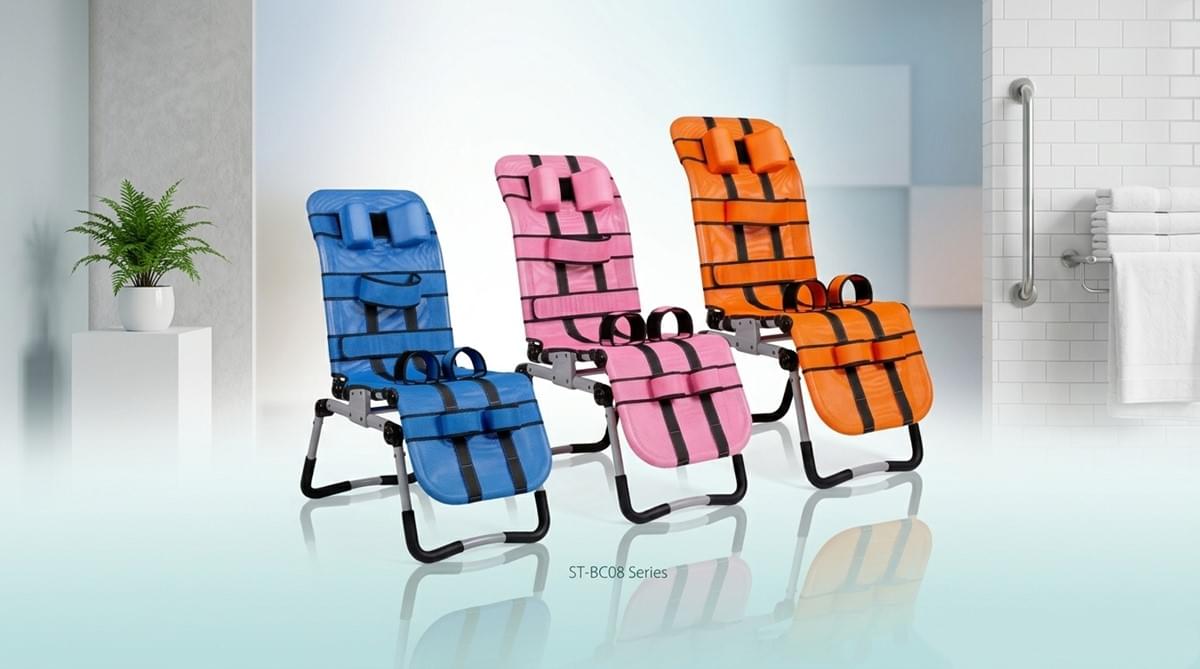
Standard pediatric shower chairs — simply a small adult design — are genuinely unsafe for children with Cerebral Palsy or other conditions requiring postural support. CP patients cannot maintain seated stability without external support; a chair that only provides a seat surface leaves them at continuous fall risk during bathing. Purpose-built CP bath chairs provide trunk support, pelvic positioning, adjustable head support, and anti-tip geometry. Size must match developmental stage (S/M/L by age group), not a generic “pediatric” label. Recommended model: ST-BC08 (pediatric CP bath chair, purpose-built for GMFCS Levels II–IV).
→ For complete clinical selection criteria across all patient types: Shower Commode Wheelchair Selection Guide for Hospitals & Care Facilities. For pediatric special needs procurement: Pediatric Cerebral Palsy Bath Chair Procurement Guide.
Shower Wheelchair OEM & Distribution: What Serious Distributors Demand from a Supplier
For distributors and OEM brand owners, product quality is only the baseline. The real differentiator is the shower wheelchair supplier‘s ability to support your commercial operations across the full business lifecycle — from first sample to year-five spare parts delivery, and from CE documentation to private label packaging.
MOQ & Sample Policy
Entry into a new regional market requires margin for error: you need to test local demand, validate product fit, and build customer relationships before committing to container-level inventory. Satcon’s standard models carry an MOQ of 10 units with 2–3 sample units available before bulk commitment. This is a deliberate commercial policy. A supplier who insists on 200-unit minimums before you have validated the market is transferring their inventory risk to you. OEM custom orders start from 50 units — workable for distributors building a private label line without full factory-scale volume.
OEM Customization — White Label vs. Private Label vs. ODM
Three models, three different commercial implications. White label: take an existing product with your branding applied — fastest to market, least differentiation. Private label: modify specifications (color, seat dimensions, accessory package, brake type) under your brand — 4–8 weeks longer lead time, higher margin protection. ODM: develop a new product to your specification using the factory’s engineering resources — 3–6 month timeline, maximum differentiation. For most distributors entering a new market, private label is the right starting point: meaningful product differentiation without the commitment of full product development. The 6-step process from RFQ to bulk shipment typically runs 8–14 weeks for private label orders.
Spare Parts Pipeline & After-Sales Support
The most common source of distributor customer churn is not product failure — it is spare parts unavailability. A facility manager whose caster breaks and cannot get a replacement part within a week will not reorder from you. Satcon maintains dedicated Beijing warehouse stock of all fast-moving components: caster assemblies, brake cables, commode buckets, footrest hardware, and upholstery panels. Standard parts ship within 48 hours. Contract distributors receive dedicated inventory allocation — your spare parts buffer is pre-stocked. For orders exceeding 200 units, on-site installation and maintenance training is available to reduce your end-customer service burden.
Container Loading & CBM Optimization
For cross-border distributors, ocean freight and warehousing volume (CBM) are silent margin killers that never appear on the product quote. A shower wheelchair with non-optimized packaging can easily consume 0.25–0.35 CBM per unit — meaning a 20-foot container holds only 140–160 units. Satcon’s packaging engineering uses knock-down shipping configuration and high-density nesting for compatible models, reducing per-unit CBM to 0.18–0.22 CBM and increasing container capacity by 20–30%. For a 200-unit order, that translates directly into measurable ocean freight savings. Ask for CBM data and container loading plans when requesting quotes — any serious supplier provides this as standard.
→ For the complete OEM customization process including compliance transfer and product development timelines: Shower Wheelchair OEM Manufacturer Guide: Private Label, Customization & Bulk Procurement.
Shower Wheelchair Certification Guide: CE, FDA & ISO Requirements by Region
Compliance is non-negotiable for institutional procurement. A CE-certified shower wheelchair is not just a regulatory checkbox — it is your legal and commercial protection. But compliance failures are more damaging than most buyers anticipate. Three real consequences:
Customs seizure: A CE certificate that does not match the product model on the commercial invoice triggers EU customs inspection. A full container held for 2–3 weeks at Rotterdam or Hamburg carries demurrage costs and delivery failure penalties that typically exceed the product value of the shipment.
Liability exposure: If an institutional buyer experiences a patient incident with non-compliant equipment, the absence of valid certification shifts liability upstream — toward the distributor and supplier. No valid CE Declaration of Conformity means no Article 13 MDR compliance, which means no defense in EU civil proceedings.
VAT refund rejection: In several export markets, customs documentation for VAT rebate processing requires compliant product certification records. Non-compliant documentation creates audit exposure for your finance team, not just your procurement team.
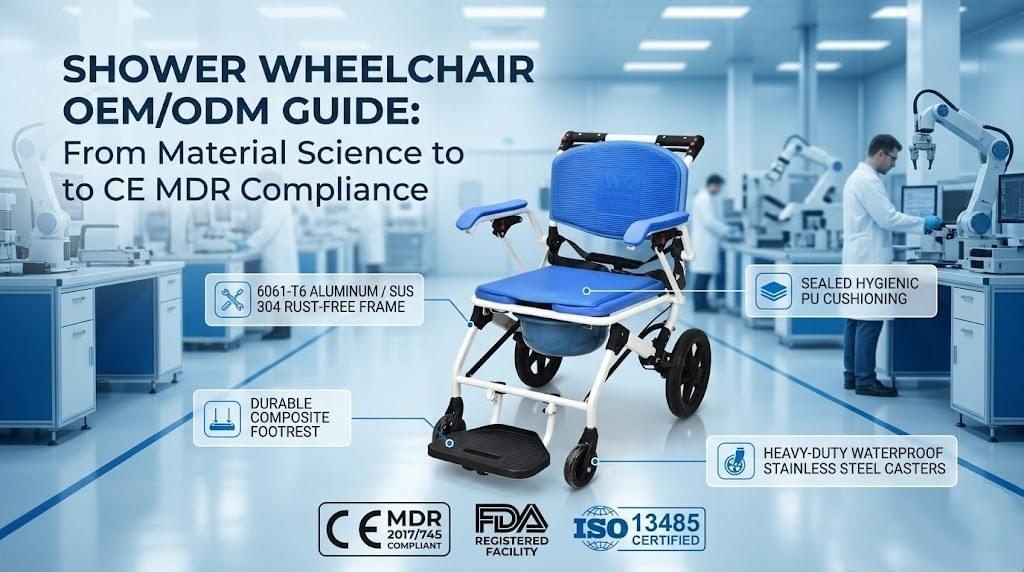
All Satcon shower wheelchairs carry CE certification and are manufactured under ISO 13485 quality management systems. For EU buyers: our Technical Documentation and EC Declaration of Conformity are model-specific and EUDAMED-registered — you receive the complete compliance package, not a summary certificate. FDA registration documentation is available for U.S.-bound shipments. UDI barcodes are applied to all EU-destined products in full compliance with the 2026 MDR mandatory timeline.
Compliance verification checklist for any shower wheelchair supplier:
- Model-specific CE Declaration of Conformity (not a factory-level generic certificate)
- ISO 13485:2016 manufacturing QMS certificate (current, not expired)
- Third-party test report referencing EN 12184 or ISO 7176 series for the specific product model
- UDI barcode on product and packaging (EU MDR 2017/745, mandatory from 2026)
- FDA Establishment Registration Number in Active status + Device Listing (searchable at fda.gov)
→ For a full regional compliance breakdown with 2026 MDR transition updates: Shower Wheelchair Safety Compliance 2026 Guide.
5-Year TCO Model & Replacement Decision Framework
There is a structural reason why healthcare facilities systematically under-specify shower wheelchairs: procurement budgets and operational budgets are managed by different teams. The procurement department optimizes for purchase price; the maintenance and nursing teams absorb the downstream cost of premature failure. When the purchasing manager who bought $80 chrome-steel chairs is not the person replacing them every 18 months at $80 each, the total cost of that decision is invisible to the decision-maker. This budget silo is the single most common cause of chronic overspending on shower wheelchair fleets.
For a 100-unit fleet in a typical nursing home, here is the 5-year cost reality:
| Purchase (100 units × aluminum) | $15,000–$22,000 |
| 5-Year maintenance & parts | $4,000–$6,000 |
| 5-Year replacements (aluminum, ~8% annual rate) | $6,000–$8,800 |
| Total 5-Year TCO (aluminum) | $25,000–$36,800 |
| Total 5-Year TCO (chrome steel, comparison) | $48,000–$72,000 |
The 50% rule for repair-vs-replace decisions applies here: if a repair costs more than 50% of the unit’s current replacement value, replace it. But for shower wheelchairs, three conditions trigger immediate replacement regardless of the 50% calculation:
Frame corrosion (any visible rust): Once rust is visible on a shower wheelchair frame in a clinical setting, the structural integrity cannot be reliably assessed without destructive testing. Any facility using a visibly corroded frame is operating an unverified structural risk in a patient-contact application. Replace immediately.
Brake failure on wet surfaces: A brake that holds on dry floor but fails to lock on wet tile is worse than no brake — it creates a false sense of security. Wet-floor brake performance must be tested periodically, not just at commissioning.
Weld joint cracks: Any visible crack in a welded joint is a structural failure in progress. There is no safe repair for a cracked weld in a load-bearing patient-handling device.
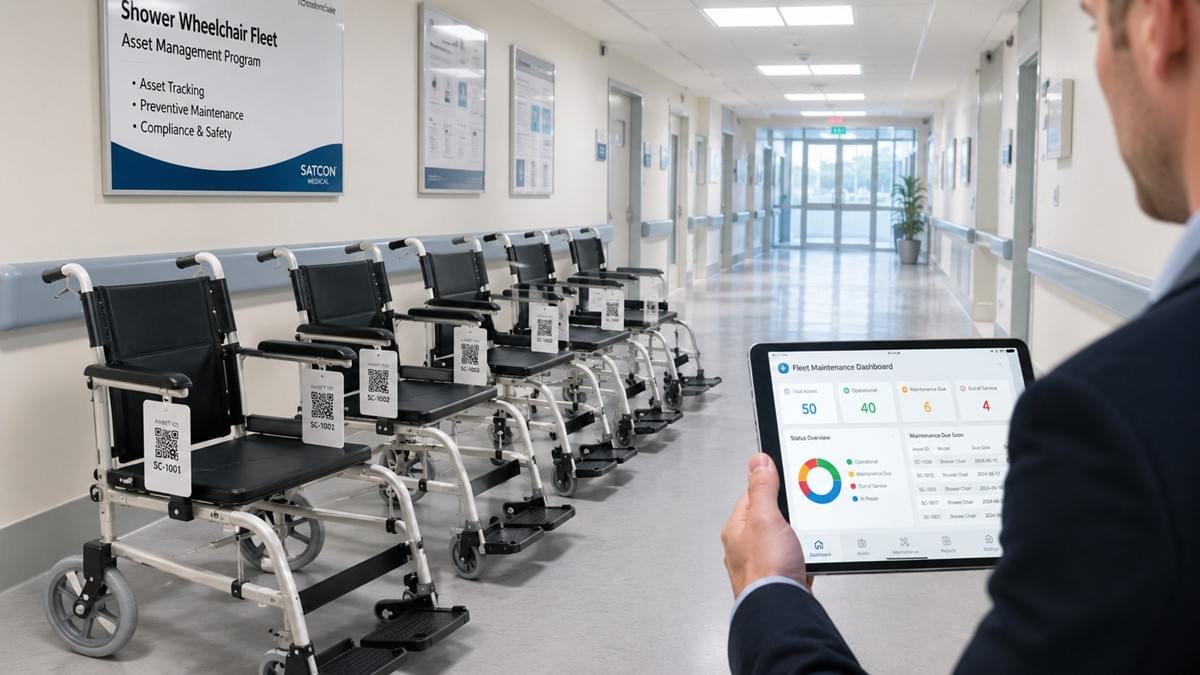
For facilities managing 20 or more shower wheelchairs, a structured fleet-level maintenance and replacement schedule reduces unplanned replacement costs by up to 30% and eliminates the compliance exposure of operating failed equipment. A fleet management guide covering inspection intervals, spare parts stocking strategy, and replacement lifecycle planning is coming soon.
Satcon Shower Wheelchair Range: 8 Models for Every Clinical Requirement
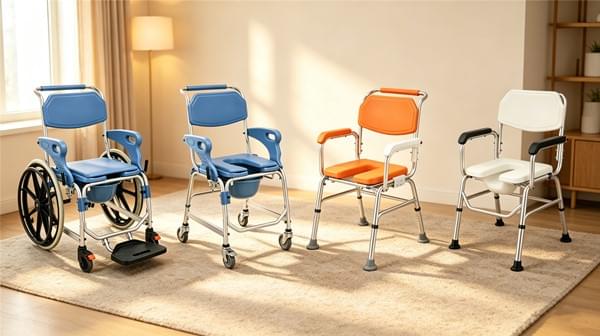
Aluminum construction, CE certification, and ISO 13485 manufacturing are not premium options in Satcon’s product range — they are the baseline specifications that every model ships with. We do not offer a non-certified version at a lower price point. Every unit a distributor or facility buys from Satcon is the same compliant product that passes the same test standards. Beyond that shared baseline, each model is engineered for a specific clinical use case:
All 8 models support OEM customization: private label branding, upholstery color selection, region-specific brake configurations, and custom compliance packaging for target markets. Minimum OEM order: 50 units. Contact Satcon to discuss a shower wheelchair supplier partnership matched to your market requirements and volume profile.
Ready to Source CE-Certified Shower Wheelchairs at Scale?
Satcon Medical has supplied aluminum shower wheelchairs to hospitals and distributors in 30+ countries since 2010. Trial orders from 10 units. OEM customization available. Full CE/FDA/ISO 13485 documentation provided. Get a quote within 24 hours.
WhatsApp: +86 13171713208 | MOQ: 10 units | Lead time: 7–15 days | ISO 13485 / CE / FDA