Bathing a child with Cerebral Palsy isn’t about downsizing a standard chair — it’s about engineering a completely different clinical support system. This pediatric cerebral palsy bath chair procurement guide covers adjustable positioning, S/M/L size selection by age group, modular accessories for GMFCS Levels I–V, and why standard pediatric shower chairs create real safety risks in CP care.
CE Certified
Wholesale Supplier
Engineered for Procurement Officers, Rehabilitation Directors, and Special Education Facility Managers.
01 The Clinical Reality
Why Standard Pediatric Shower Chairs Are Risky for CP Patients
A standard pediatric shower chair is designed for a child who can sit upright. Cerebral Palsy (CP) children cannot — and forcing them into equipment that was never engineered for their condition creates a cascade of clinical and financial risks. As established in our Shower Wheelchair Procurement & Safety Guide, the right equipment must match the patient’s real clinical needs — and CP children have fundamentally different needs from the general pediatric population.
❌ Zero Trunk Control vs. Fixed Backrests
Reality: CP children experience abnormal muscle tone — spastic (high tone) or hypotonic (low tone) — and cannot independently maintain an upright sitting posture.
Consequence: Standard bath chairs lack angle adjustability. Without posterior tilt or recline support, CP patients slide forward or collapse sideways. Bathing requires two caregivers to hold the child throughout — doubling labor cost per bath and creating a fall hazard the moment either caregiver releases their grip.
❌ No Postural Positioning vs. Involuntary Movements
Reality: Startle reflexes and abnormal muscle tone cause uncontrolled twisting, arching, or rigid extending of limbs. This is not behavioral — it is neurological.
Consequence: Anti-slip surfaces on standard chairs cannot counter involuntary movement. The child’s body distorts out of position, making bathing inefficient and increasing the risk of skin abrasion from friction against fixed frame edges. Without positioning straps and lateral supports, the chair actively worsens the clinical situation.
❌ Age ≠ Anatomy: The Size Trap
Reality: Many standard chairs are simply adult designs scaled down by age. But CP children have disproportionate body dimensions — shortened limbs with average or enlarged torsos, or vice versa.
Consequence: Ordering by age alone produces mismatched equipment. Chairs sit idle in storage because the seat depth is wrong, the back height doesn’t support the child’s actual posture, or the calf length creates circulation issues. Facilities end up re-purchasing within 2–3 years — or worse, using the wrong size and accepting the injury risk.
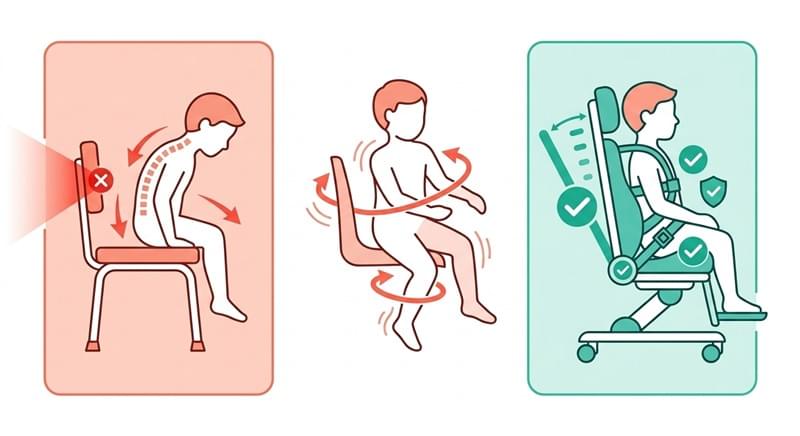
For pediatric cerebral palsy bath chair procurement, the clinical requirement is clear: you need adjustable positioning, growth-adaptable sizing, and modular postural support — features that standard pediatric shower chairs simply do not have. Looking for the regulatory framework? Read our Guide on CE/FDA Medical Device Certifications for Exporting (Cluster #2).
02 Technical Specifications
5 Core Specifications That Define a Clinical CP Bath Chair
Before placing a wholesale adjustable cerebral palsy bath chair order, verify that every unit meets these five clinical parameters. Missing any one of them means the chair will underperform — or fail outright — in a CP care environment.
① Independent Backrest & Seat Angle Adjustability
Both the backrest angle and the seat surface angle must be independently adjustable — not just a single recline axis. High-tone (spastic) patients require posterior tilt to reduce extensor spasms; low-tone (hypotonic) patients need a specific anterior tilt to prevent forward sliding. One-button adjustment allows caregivers to reposition without lifting the child out of the chair. This dual-angle system is the single feature that separates a pediatric cerebral palsy bath chair from a consumer-grade bath seat.
② S/M/L Growth-Adaptable Size Range
Children grow fast — CP children’s equipment replacement cycle is typically 3 years versus 5–8 years for adults. A three-tier sizing system (S: ages 1–6, M: ages 4–12, L: ages 9–16) with adjustable seat height (15–38 cm range) extends each size’s usable period and reduces the total cost of ownership for the facility. When ordering from a bulk pediatric cerebral palsy bath chair supplier, specify all three sizes in a mixed order to cover your full patient age range.
③ Antibacterial, Quick-Dry Mesh Upholstery
CP children often have compromised skin integrity and reduced sensation — they cannot shift position to relieve pressure. Prolonged exposure to moisture creates a real pressure ulcer risk. Antibacterial, quick-dry, breathable mesh that is fully removable for machine washing meets hospital infection control protocols and prevents cross-contamination between patients. This is not a luxury feature — it is a clinical necessity in any special needs bath chair for hospitals wholesale order.
④ Multi-Point Safety Straps & Posture Supports
A standard lap belt is insufficient for CP patients with involuntary movements. A clinical positioning pediatric bath chair requires a multi-point strap system — typically a thoracic (chest) strap plus a lap belt — to prevent forward sliding and lateral lean. These straps must secure the child without restricting breathing or circulation, and must be operable by a single caregiver. Without proper postural positioning, one caregiver cannot safely bathe a CP child alone.
⑤ Modular Accessory System for GMFCS Levels
CP severity spans five levels on the Gross Motor Function Classification System (GMFCS I–V). A GMFCS Level II child may need only a safety belt; a Level V child requires head support, lateral trunk pads, and full-body positioning. A modular accessory system — head support pillow, lumbar support pad, and safety belt, all removable and quick-dry — lets one pediatric special needs bathing chair manufacturer serve your entire CP patient spectrum. When sourcing from a custom pediatric special needs bath chair factory, specify that accessories must be compatible across all size tiers.
Need help matching chairs to patient conditions? See our Clinical Selection Matrix by Patient Type.
03 B2B Segment
Custom Ordering Solutions: Matching Chairs to Your Facility’s Needs
Different facilities serve different CP populations with different priorities. The right pediatric cerebral palsy bath chair configuration depends on whether your primary concern is infection control, hydrotherapy, or long-term fleet durability.
🏥 For Children’s Hospitals
Procurement priority: High-frequency use, infection control compliance, rapid patient turnover.
Configuration: S/M/L mixed order covering all pediatric wards. Standard configuration: antibacterial removable mesh upholstery on every unit, safety belts included. Multiple sizes per ward to match admitted patient demographics — do not wait for a size mismatch to surface during a busy shift.
As a hospital pediatric bath chair supplier, Satcon provides complete infection control compliance documentation and material safety data sheets for all upholstery components.
♿ For Rehabilitation Centers
Procurement priority: Hydrotherapy angle adjustment, modular accessory packages, and lightweight portability between treatment rooms.
Configuration: Full accessory package (head support pillow + lumbar pad + safety belt) to cover GMFCS Levels I–V with one base model. The 6061 aluminum frame keeps the net weight at 5.3–6.0 kg — light enough for therapists to carry between treatment rooms without mechanical lifts. Fold-flat design for compact storage when not in active use.
We offer positioning pediatric bath chair wholesale tiered pricing for day rehab centers, updating equipment on a rolling schedule.
🎓 For Special Education Schools
Procurement priority: Long-term durability, bulk uniform specifications, color-coded class management.
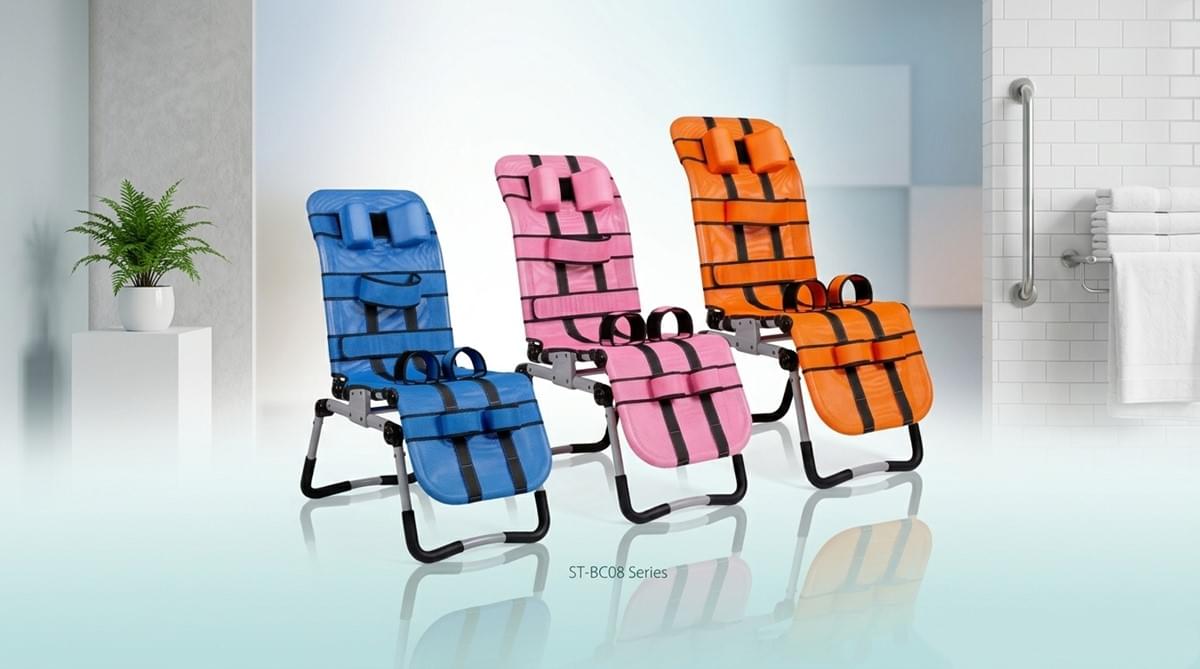
Configuration: Bulk order by age bracket — S for early intervention classes, M for primary, L for secondary. Three available colors (blue, pink, orange) enable color-coded assignment by classroom, functional level, or building wing. Uniform specification across the fleet simplifies staff training, spare parts inventory, and annual asset audits.
As a bulk pediatric cerebral palsy bath chair supplier, Satcon supports school district tender specifications and provides consolidated compliance documentation for institutional procurement.
Regardless of facility type, every CE-certified pediatric cerebral palsy bath chair must carry a valid Declaration of Conformity, FDA registration records, and an ISO 13485 quality management system certification. Verify these before committing to any supplier.
04 Satcon ST-BC08
Satcon ST-BC08 Pediatric CP Bath Chair Specifications
The ST-BC08 was engineered from the ground up for CP and special needs children — not adapted from an adult design. Every specification addresses a clinical requirement identified in Sections 01–02.
Technical Data Sheet (S/M/L Comparison)
| Parameter | Small (S) | Medium (M) | Large (L) |
|---|---|---|---|
| Age Range | 1–6 years | 4–12 years | 9–16 years |
| Seat Depth | 28 cm | 35 cm | 40 cm |
| Seat Width | 43 cm | 43 cm | 43 cm |
| Back Height | 49 cm | 60 cm | 71.5 cm |
| Seat-to-Floor Height | 15–29.7 cm | 15–33.8 cm | 15–38 cm |
| Calf Length | 25 cm | 29.5 cm | 34 cm |
| Overall Length | 100 cm | 123 cm | 143 cm |
| Overall Width | 43.8 cm | 43.8 cm | 43.8 cm |
| Net Weight | 5.3 kg | 5.7 kg | 6.0 kg |
| Safe Working Load | 73 kg (160 lbs) | 73 kg (160 lbs) | 73 kg (160 lbs) |
Why Satcon Is the Preferred OEM/ODM Factory
🛡️ Aerospace-Grade 6061 Aluminum
Only 5.3–6.0 kg net weight — compared to 10–15 kg for adult-adapted models. That’s a 50% reduction in lifting burden for caregivers who move the chair multiple times per day. 6061-T6 alloy is rust-proof for the lifetime of the equipment, even with daily exposure to chlorinated water and chemical disinfectants.
🔄 Full Quick-Dry System
Every fabric component — seat mesh, backrest upholstery, safety straps, and all accessory pads — is removable and quick-drying. No seams where moisture collects. No fabric that stays damp between patients. This eliminates the primary vector for cross-contamination in shared pediatric equipment and satisfies hospital infection control audit requirements.
🧩 Modular Accessory Ecosystem
Head support pillow for GMFCS IV–V patients who lack neck control. Lumbar support pad for children with trunk instability. Multi-point safety belt standard on every unit. All accessories are interchangeable across S/M/L frames and snap on/off without tools — one accessory inventory serves your entire fleet.
🛡️ CE Certified · FDA Registered · ISO 13485 Certified · Compliance Documents & Sample Policy Available upon Request
OEM & Customization: Frame color (blue/pink / orange/custom Pantone), seat width, accessory package configuration, and private-label branding available. Photorealistic mockups and technical drawings are provided before production commitment. As a custom pediatric special needs bath chair factory, we support your tender specifications with exact documentation.
Full technical specifications and compliance documentation available on the ST-BC08 product page.
Need a CP Bath Chair That Actually Fits Your Patients?
Tell us your patient age range and GMFCS level distribution. We’ll recommend the right size mix, accessory package, and provide full CE/FDA compliance documents plus tiered bulk pricing — before you commit to anything.
WhatsApp: +86 183 3183 3767 · Email: sales@satconmed.com
Frequently Asked Questions
What makes a cerebral palsy bath chair different from a standard pediatric shower chair?
A standard pediatric shower chair assumes the child can maintain an upright sitting posture independently. A pediatric cerebral palsy bath chair is engineered for children who cannot — it provides independent backrest and seat angle adjustability for postural positioning, multi-point safety straps to control involuntary movements, and modular accessories (head support, lumbar pad) that scale with GMFCS severity. Without these features, CP children risk sliding, falling, or developing pressure injuries during bathing.
What size cerebral palsy bath chair should a hospital order for different age groups?
For hospitals with mixed-age pediatric wards, a mixed S/M/L order is recommended: Small (ages 1–6) for early intervention and neonatal follow-up wards, Medium (ages 4–12) for general pediatrics, and Large (ages 9–16) for adolescent units. The age ranges overlap intentionally — always size by the child’s actual body measurements (seat depth, back height, calf length) rather than age alone, as CP children often have disproportionate body dimensions. As a hospital pediatric bath chair supplier, Satcon provides a sizing worksheet with each order to help ward staff match patients to the correct chair.
Can a CP bath chair be used for hydrotherapy and pool rehabilitation?
Yes — provided the frame is made from corrosion-resistant material and the upholstery is quick-drying. The ST-BC08 uses 6061-T6 aluminum (naturally rust-proof) and fully removable, quick-dry mesh fabric, making it suitable for hydrotherapy and pool-based rehabilitation programs. The adjustable backrest and seat angles allow therapists to position patients for specific water-based exercises. When ordering for hydrotherapy use, specify the positioning pediatric bath chair wholesale package with full accessory kit for maximum clinical flexibility.
Is a CE certified pediatric cerebral palsy bath chair required for European hospital procurement?
Yes. In the European Union, pediatric bath chairs intended for clinical use are classified as medical devices under EU MDR 2017/745. Any CE certified pediatric cerebral palsy bath chair placed on the EU market must carry a valid Declaration of Conformity, bear the CE marking, and be registered in EUDAMED. Public healthcare institutions in EU member states are required to verify compliance documentation before accepting delivery. Satcon provides the complete compliance file — including EC Declaration of Conformity, FDA registration, ISO 13485 certificate, and third-party test reports — with every shipment.