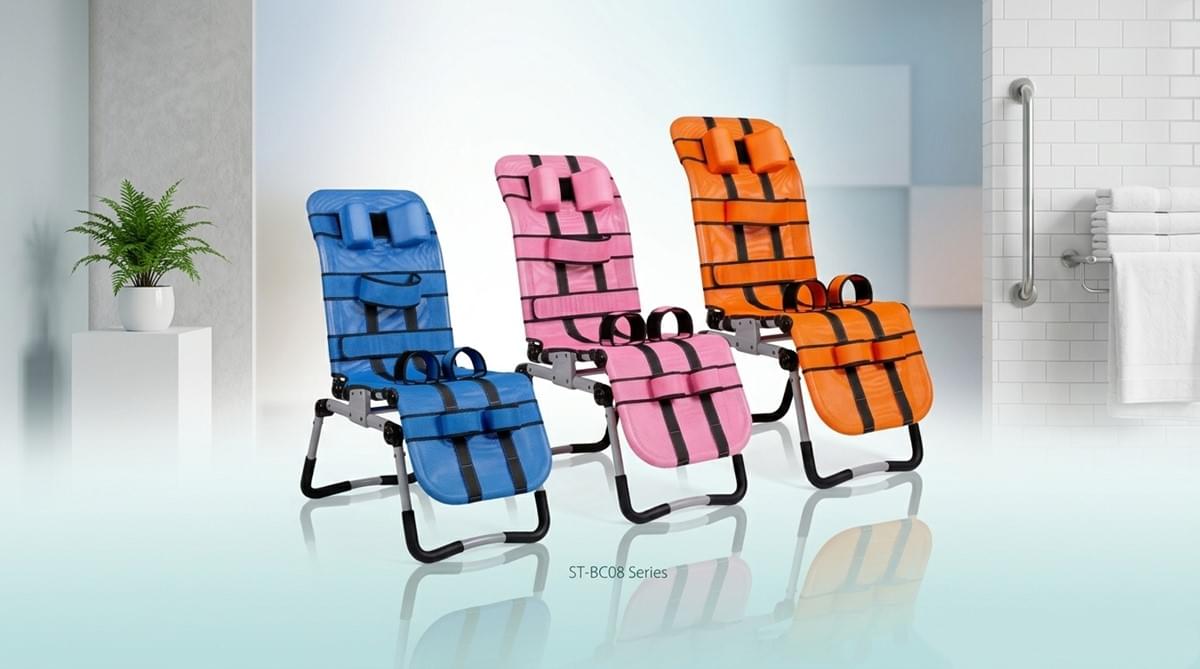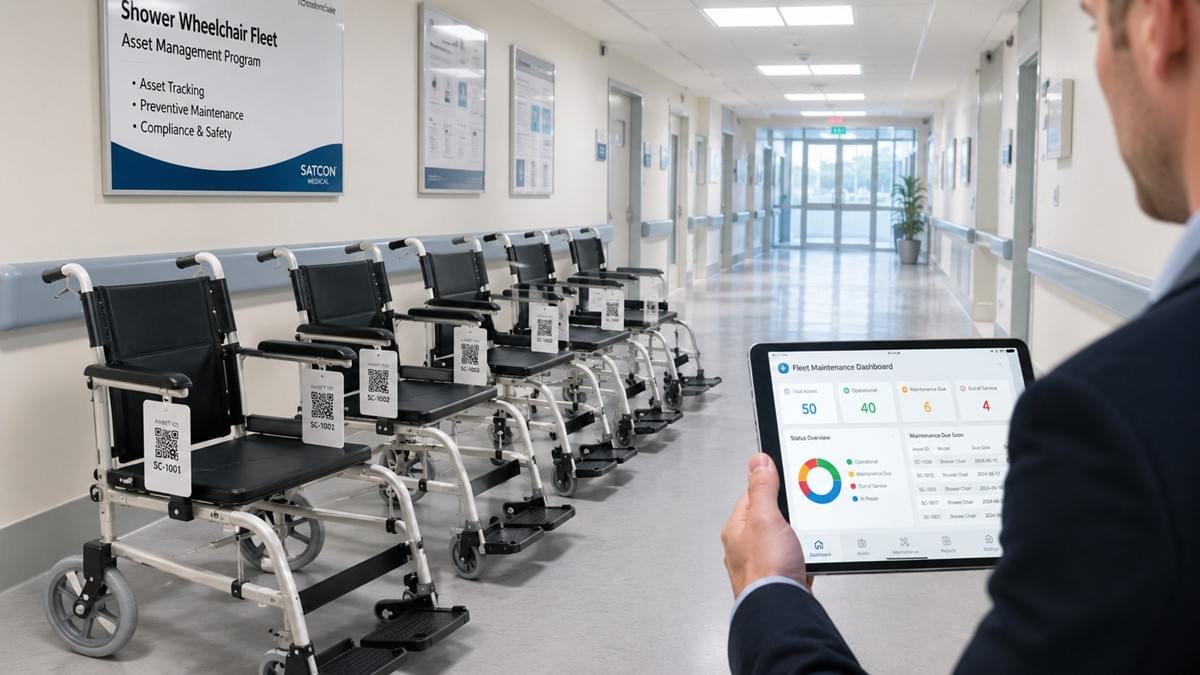
Shower wheelchair fleet management becomes increasingly important as healthcare organizations move from managing a few chairs to coordinating dozens across hospitals, nursing homes, and distribution networks. At that scale, maintenance records, replacement planning, inventory control, and equipment availability all become part of daily operations.
Rather than waiting for equipment to fail, a structured fleet management approach helps organizations schedule preventive maintenance, track asset condition throughout its service life, and plan replacements more predictably. The result is typically fewer unexpected repairs, longer equipment life, and lower long-term operating costs.
30% while keeping equipment availability above 95%.
shower chair maintenance schedule
shower wheelchair replacement cycle
shower wheelchair supplier
S01 — Why Managing 50 Shower Wheelchairs Is Different from Managing One
Managing a few shower wheelchairs individually is usually manageable. Maintenance is often performed only when a chair develops a problem, a repair request is submitted, and replacement parts are ordered as needed.
As the number of shower wheelchairs increases across hospital departments, nursing homes, or care facilities, this reactive approach becomes more difficult to sustain. Missed inspections, unexpected equipment failures, inconsistent maintenance records, and urgent replacement requests can gradually affect daily operations and increase operating costs.
A structured shower wheelchair fleet management program introduces consistent maintenance schedules, asset identification, lifecycle tracking, and centralized documentation. Instead of responding to problems after they occur, facilities can identify wear earlier, plan repairs during scheduled maintenance, and make replacement decisions based on equipment condition. This helps improve equipment availability while making maintenance activities easier to manage and document.
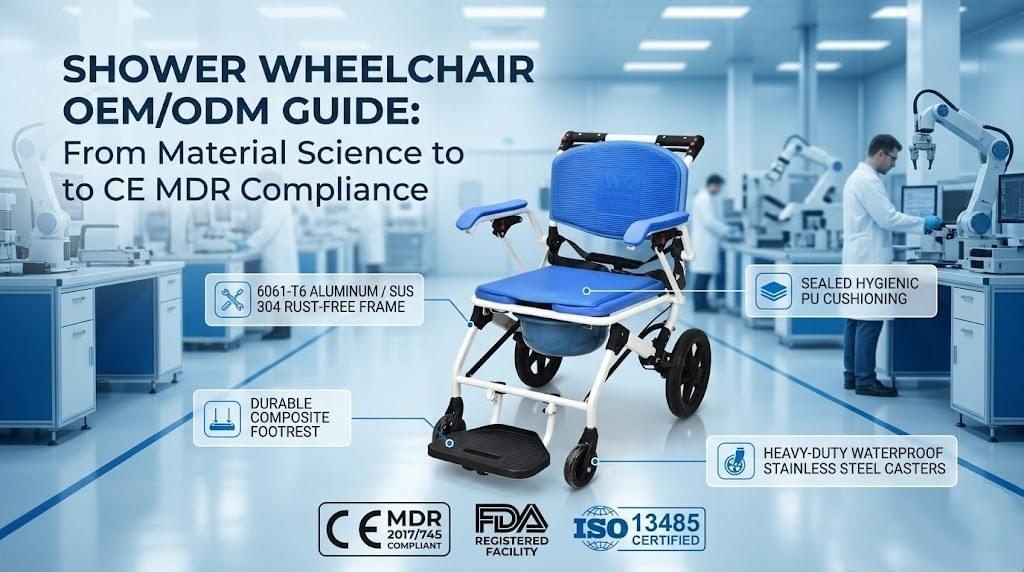
Before building a maintenance program, it’s worth making sure the fleet is built on the right equipment. Our shower wheelchair procurement & safety guide explains how to evaluate frame materials, safety features, and purchasing considerations for different care environments.
S02 — The Shower Wheelchair Lifecycle Framework
A properly managed shower wheelchair fleet management system treats each chair as an asset with a full lifecycle — from the purchase order to the final disposal record. The following six-stage framework is what hospitals and institutional buyers should expect from any serious supplier or internal asset management program.
1
Purchase & Asset Registration
Every shower wheelchair entering the fleet receives a unique asset ID (engraved tag or QR code) linked to purchase date, warranty term, model number, and assigned unit or floor. This is the foundation of every downstream process.
2
Daily Visual Inspection
A laminated 5-point checklist attached to each chair: brake function, frame/caster integrity, seat cushion condition, commode bucket seal, and visible corrosion. Nursing staff complete this in under 60 seconds during shift handover. Any flagged item automatically triggers a maintenance work order.
3
Preventive Maintenance
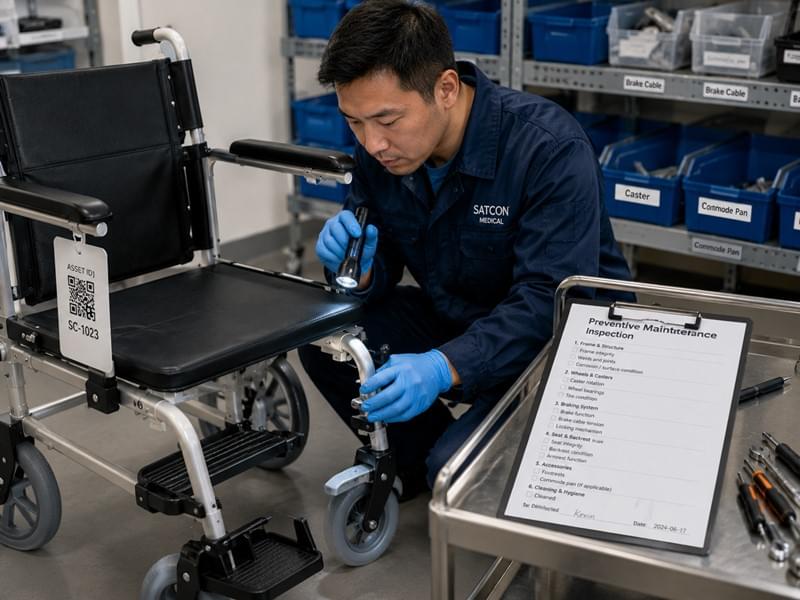
Scheduled inspections at intervals calibrated by usage intensity: high-frequency chairs (4+ hours/day) get monthly checks; standard chairs quarterly; low-use chairs semi-annually. Each inspection covers 12 checkpoints: brakes, casters, frame welds, seat hardware, armrests, footrests, commode aperture seal, push handles, anti-tippers, bearing smoothness, corrosion spots, and labeling legibility.
4
Repair & Component Replacement
When a preventive inspection or daily check flags an issue, the maintenance team executes a standardized repair using original-spec components. Every replaced part — brake cable, caster, seat cushion — is logged against the asset ID with a batch number for traceability.
5
Retirement Decision
Each chair receives a formal retirement evaluation at 3 years (high-frequency use) or 5 years (standard use), or immediately if any structural or infection-control threshold is breached. The retirement decision matrix in S03 provides the objective criteria.
6
Disposal & Audit Archive
Retired chairs are decommissioned with a formal disposal record: date, reason for retirement, final inspection findings, and destruction or recycling method. This file stays in the audit archive for a minimum of 5 years to support ISO 13485 and Joint Commission compliance reviews.
S03 — Replacement Cycle: When to Retire a Shower Wheelchair
Shower wheelchairs operate in the harshest environment in any healthcare facility: constant water exposure, high humidity, chemical disinfectant contact, and frequent thermal cycling (hot shower water followed by ambient air drying). This accelerates corrosion and material fatigue well beyond what standard manual wheelchair lifecycle models predict.
A shower wheelchair replacement cycle should be planned, not reactive. The Retirement Decision Matrix below gives maintenance teams and procurement managers an objective, auditable standard for determining when to replace a chair.
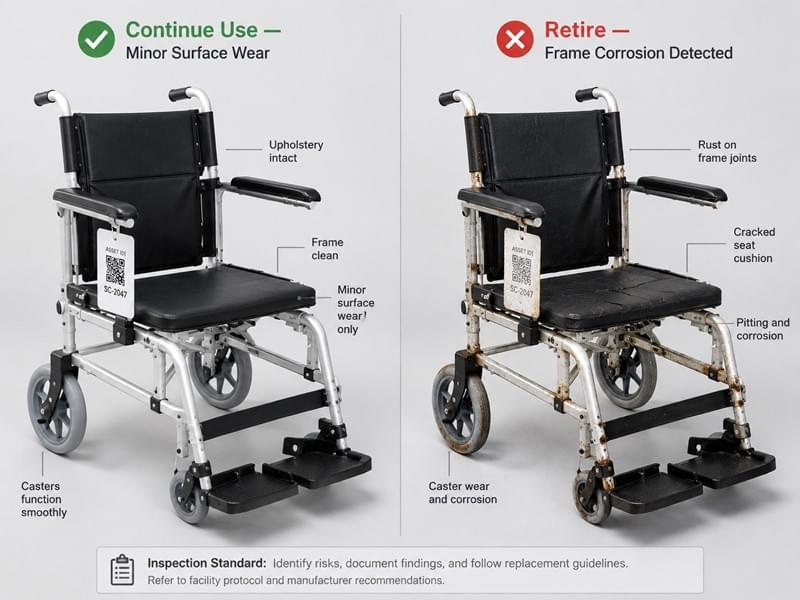
| Condition Observed | Recommended Action | Urgency |
|---|---|---|
| Cosmetic scratches, minor surface discoloration | Continue using — document in inspection log | 🟢 Routine |
| Surface rust spots on frame (no pitting) | Monitor closely — increase inspection frequency to monthly | 🟡 Watch |
| Bearing roughness, caster noise, or uneven rotation | Replace component — continue using chair | 🟡 Watch |
| Cushion cracking with foam exposure | Replace cushion immediately — infection control risk | 🟠 Urgent |
| Frame crack at weld joint or structural member | Retire immediately — do not attempt repair | 🔴 Critical |
| Brake failure after repair attempt | Retire immediately — patient safety risk | 🔴 Critical |
Special note on chrome-plated steel chairs: Once the chrome layer is compromised (visible rust or pitting), the corrosion accelerates exponentially in wet environments. A chrome-plated steel shower chair showing any rust should not be reassigned to a wet-area unit. For a full comparison of frame materials in wet environments, see our aluminum vs. steel shower wheelchair durability analysis.
S04 — Inventory & Spare Parts Strategy
Effective shower wheelchair inventory management is the difference between a 2-hour repair and a 2-week wait. For institutions managing fleets of 20+ chairs, a structured spare parts program eliminates the single largest cause of equipment downtime: waiting for parts.
Minimum Spare Parts Stock by Priority
| Priority | Parts | Recommended Qty (per 20 chairs) | Rationale |
|---|---|---|---|
| P0 — Always in Stock | Brake cable assemblies, caster wheel assemblies, commode buckets | 3–5 units each | Failure of any of these renders chair unusable; highest wear rate |
| P1 — Recommended Stock | Seat cushions, armrest pads, footrest assemblies | 2–3 units each | Moderate wear rate; directly affects patient comfort and infection control |
| P2 — As-Needed | Frame components, wheel hubs, bearings, anti-tippers | 0–1 unit each | Low failure rate; order when 2+ units in fleet show early wear signs |
For facilities placing routine orders, a simple safety stock formula prevents both shortages and overstock:
5 Fleet Performance KPIs Every Institution Should Track
Hospitals and nursing homes commonly monitor these five metrics to evaluate fleet health:
➔ Fleet Availability Rate — Target: ≥ 95%. Calculated as: (Total chairs − chairs out of service) ÷ Total chairs.
➔ Preventive Maintenance Completion Rate — Target: ≥ 90%. Percentage of scheduled inspections completed on time.
➔ Emergency Repair Frequency — Target: < 1 breakdown per 10 chairs per month. Indicates whether preventive maintenance is effective.
➔ Spare Parts Turnover Rate — Measures how quickly inventory moves. High turnover on P0 parts is normal; high turnover on P2 parts signals a fleet-wide issue.
➔ Average Replacement Age — Tracked per chair. If the fleet average retirement age consistently falls below 3 years, the procurement specification or material selection should be reviewed.
For distributors managing multiple client fleets, centralized spare parts warehousing with 48-hour dispatch is a competitive differentiator. See our OEM shower wheelchair manufacturer guide for custom parts sourcing and branding options.
S05 — Compliance & Audit Readiness
Maintenance logs are not administrative paperwork — they are legal protection. When a patient injury involving equipment occurs, the first question investigators ask is: “Show us the maintenance records.” A complete, well-organized log demonstrates that the facility exercised reasonable care. A missing or incomplete log shifts liability toward the institution.
Maintenance records support four critical compliance frameworks:
▶ ISO 13485 Quality Management — Requires documented evidence that medical devices are maintained according to manufacturer specifications throughout their service life.
▶ Joint Commission Inspections — EC.02.04.01 and EC.02.04.03 standards mandate that healthcare facilities maintain, inspect, and test medical equipment on a defined schedule with written records.
▶ Internal Risk Management — Maintenance logs are the facility’s primary defense in incident investigations, proving that equipment was not operated in a state of known disrepair.
▶ Supplier Warranty Claims — Manufacturers require documented proof of scheduled maintenance to honor warranty claims. Without logs, defective-part claims are routinely denied.
Maintenance Log — Minimum Required Fields
☑ Asset ID and inspection date
☑ Maintenance type: Routine / Repair / Component Replacement / Retirement
☑ Inspector name and signature
☑ Replaced part batch numbers (for traceability)
☑ Next scheduled maintenance date
Digital logging via QR-code scanning is increasingly replacing paper logs in larger institutions. QR codes on each chair link directly to a cloud-based maintenance record, reducing data-entry errors and preventing the all-too-common problem of “missing logbook” during audits.
S06 — Fleet TCO: Total Cost of Ownership
Procurement managers increasingly evaluate equipment through Total Cost of Ownership (TCO) rather than purchase price alone. For a 50-chair shower wheelchair fleet, the purchase invoice represents less than 50% of the five-year cost. The following breakdown uses conservative industry averages.
| Cost Dimension | Reactive Management (5-Year) | Fleet Management (5-Year) |
|---|---|---|
| Initial Purchase (50 chairs) | $17,500 | $17,500 |
| Scheduled Maintenance (labor + parts) | $6,200 | $7,800 |
| Emergency Replacements | $14,000 | $4,200 |
| Emergency Procurement Premium (rush fees) | $5,300 | $1,500 |
| Nursing Overtime (equipment unavailability) | $5,000 | $1,500 |
| TOTAL 5-Year TCO | $48,000 | $32,500 |
The fleet management approach saves $15,500 over 5 years — a 32% reduction in total cost of ownership. The largest savings come from eliminating emergency replacements and rush procurement premiums, both of which are direct consequences of reactive maintenance.
Fleet management is not an administrative expense — it is a 32% cost reduction strategy with an audit-ready paper trail built in.
Ready to implement fleet management for your facility? Contact Satcon Medical for a fleet assessment and spec your next order with a trusted shower wheelchair supplier.
Frequently Asked Questions
How often should shower wheelchairs be inspected?
Chairs used 4+ hours daily require monthly preventive maintenance inspections. Standard-use chairs (1–3 hours daily) should be inspected quarterly. Low-use chairs can follow a semi-annual schedule. Every chair should receive a daily visual check (brakes, casters, seat condition) by nursing staff regardless of formal inspection schedule.
How long does a shower wheelchair typically last?
Aluminum alloy shower wheelchairs with proper maintenance average 5–7 years. Chrome-plated steel chairs in wet environments average 3–4 years before corrosion compromises structural integrity. High-frequency use (daily, multiple patients) reduces these estimates by approximately 30%.
What spare parts should healthcare facilities keep in stock?
At minimum, facilities should stock brake cable assemblies, caster wheel assemblies, and commode buckets (3–5 units per 20 chairs). Seat cushions and armrest pads are recommended as secondary stock (2–3 units per 20 chairs). A safety stock calculation of (Monthly Usage Rate × Lead Time) + 20% buffer helps determine optimal quantities for each facility’s specific fleet.
When should a shower wheelchair be retired?
A shower wheelchair should be retired immediately if any of these conditions are found: frame crack at a weld joint, brake failure after repair, or cushion foam exposure creating an infection control risk. Additionally, chairs reaching 3 years of high-frequency use or 5 years of standard use should undergo a formal retirement evaluation even if no single failure condition is present.
Get Your Free Fleet Management Toolkit
Download three free resources to start managing your shower wheelchair fleet today:
✓ Shower Wheelchair Maintenance Log — Printable template with all 5 required audit fields
✓ Fleet Inspection Checklist — 12-point laminated checklist for daily and scheduled inspections
✓ Replacement Planning Spreadsheet — Forecast replacement needs by chair age, usage, and material type
Facilities with 20+ shower wheelchairs qualify for a free fleet assessment consultation.