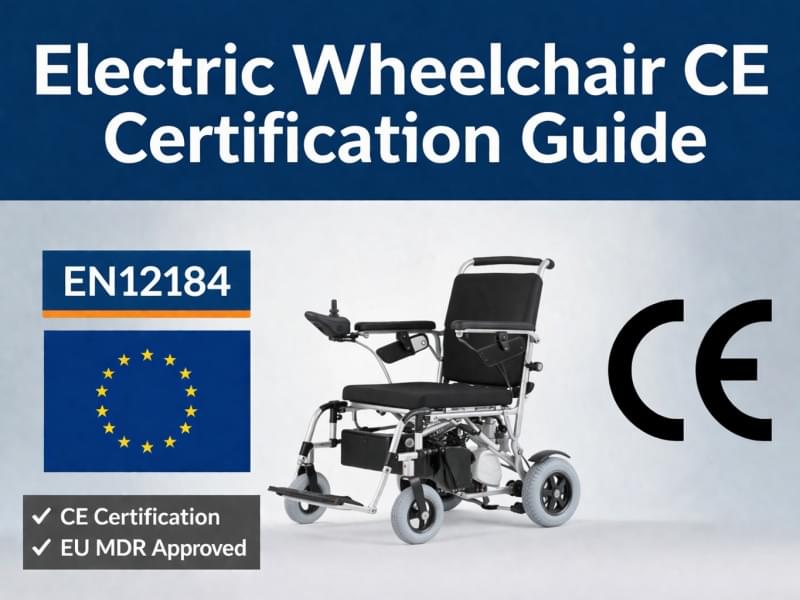
MDR Compliant Electric Wheelchair · EN12184 Tested · ISO 13485 Manufacturer · EU Market Ready
Avoid customs delays, compliance risks, and rejected shipments by understanding electric wheelchair CE certification requirements before sourcing.
€2.5B+
EU Market Size
Growing demand for power mobility solutions
1–3 Months
Customs Delay Risk
Caused by incomplete CE documentation
5 Core Tests
EN12184 Requirements
Stability, braking, EMC, climbing & fire safety
Europe remains one of the most attractive yet tightly regulated markets for mobility devices. For importers, distributors, and wholesalers, electric wheelchair CE certification is no longer something handled at the final stage—it is a fundamental requirement that determines whether a product can actually enter and circulate within the European Union.
In today’s market, electric wheelchair CE certification sits at the center of compliance. Without it, even well-manufactured products can be held at customs, refused entry, or excluded from public healthcare tenders and institutional purchasing programs.
For European buyers sourcing electric wheelchairs internationally, understanding EN12184 testing requirements and MDR compliance is essential. It is not just about passing inspections—it directly affects how smoothly shipments clear customs, how products perform in real use, and whether they can be legally sold and supported over time.
Electric Wheelchair CE Certification Requirements for Europe
Under the Medical Device Regulation (EU) 2017/745, electric wheelchairs are classified as medical devices and must meet strict regulatory requirements before being placed on the EU market.
This framework replaces the former MDD directive and introduces significantly higher compliance standards across the entire product lifecycle.
Unlike the previous “self-declaration” model, manufacturers must now maintain a complete and continuously updated Technical File, supported by testing data and risk management documentation.
Why Electric Wheelchair CE Certification Determines EU Market Access
Electric wheelchair CE certification is not just a label—it is the legal foundation for market entry across all EU member states.
- Products cannot legally be sold in Europe
- Customs clearance may be delayed by 1–3 months or rejected
- Importers and distributors assume full liability
- Participation in healthcare tenders becomes impossible
In practice, electric wheelchair CE certification determines whether your supply chain operates smoothly or faces costly disruptions.
EN12184 Electric Wheelchair Standard Explained
The EN 12184:2014 standard defines the core safety and performance requirements for electric wheelchairs in Europe.
Any EN12184 electric wheelchair must pass this standard to qualify for CE certification.
However, experienced buyers know that the key issue is not whether a product claims compliance—but how it performs under real testing conditions.
Key EN12184 Testing Areas and Their Real-World Impact
Prevents tipping under load. Failures often come from poor frame geometry or center-of-gravity misalignment.
Ensures safe stopping and slope holding. Critical in urban European environments.
Tests sustained performance under load. Reveals motor and controller matching quality.
Prevents interference with medical devices and ensures operational stability.
All materials must meet flame-retardant standards—often a hidden compliance risk.
Why Certified Samples Don’t Guarantee Compliant Shipments
The most costly mistake experienced importers make is assuming that a CE-certified sample guarantees full compliance across mass production.
In reality, the gap between tested prototypes and large-scale manufacturing is where most compliance failures occur—often after shipment.
| Risk Area | What Happens | Consequence | What to Verify |
|---|---|---|---|
| Battery substitution | Lower-spec cells used in production | Fails load cycling; customs detention | Request batch-level battery specifications |
| Controller mismatch | Firmware or motor specs changed | Unstable braking; test failure | Verify controller BOM vs test report |
| Weld inconsistency | Passes visual QC but fails fatigue | Structural failure risk | Review welding inspection records |
| Incomplete Technical File | Only partial model documentation | Customs rejection; liability | Confirm SKU-specific DoC |
| Non-compliant materials | Foam or plastics replaced | Fails fire resistance tests | Request material certificates per batch |
Working with an ISO 13485 wheelchair manufacturer directly reduces these risks. The system enforces strict traceability, documented change control, and production consistency.
Any component substitution must go through a formal validation process—not an informal production decision.
How to Choose a Reliable CE Certified Electric Wheelchair Supplier
Selecting a reliable CE-certified electric wheelchair supplier requires more than simply checking for a CE mark. In practice, what matters is whether the supplier can consistently maintain compliance across production, documentation, and shipment—not just in a single tested sample.
1. Model-specific EN12184 test reports
Always request the full test report for the exact model you plan to purchase. Generic reports or reports from similar models are not sufficient for EU compliance verification.
2. Valid ISO 13485 certification
This ensures the manufacturer operates under a controlled quality management system, with proper traceability and change control in place.
3. Complete MDR Technical File
A compliant supplier should be able to provide a structured Technical File, including risk management, testing data, and conformity documentation.
4. Proven EU export experience
Suppliers with established shipments to European markets are more familiar with customs requirements, documentation standards, and in-market expectations.
5. UDI and EUDAMED compliance
The supplier should understand device identification requirements and be able to support registration and labeling in line with MDR expectations.
A qualified electric wheelchair manufacturer exporting to Europe should provide all required compliance documentation before order confirmation, not after shipment. This includes essential documents like the Declaration of Conformity, EN12184 test reports, and ISO 13485 certification.
By providing these documents upfront, manufacturers ensure smoother customs clearance, minimize delays, and demonstrate their commitment to meeting EU regulatory standards. This approach not only builds trust with European buyers but also supports long-term business relationships.
Documentation Checklist for EU Customs Clearance
| Document | Purpose |
|---|---|
| Declaration of Conformity | Legal proof of CE compliance |
| EN12184 Test Report | Safety and performance verification |
| Technical File | Engineering and compliance documentation |
| UDI & EUDAMED | Regulatory traceability requirement |
| ISO 13485 Certificate | Quality system validation |
Electric Wheelchair CE Certification FAQ
What CE certification is required for electric wheelchairs in Europe?
Electric wheelchairs sold in the EU must comply with MDR (EU) 2017/745, pass EN12184 safety and performance testing, and have a complete Technical File along with a Unique Device Identification (UDI) registration.
Why is EN12184 important for electric wheelchairs?
EN12184 defines the core safety and performance requirements for electric wheelchairs in Europe. Compliance ensures devices meet stability, braking, EMC, fire resistance, and climbing ability standards, which is mandatory for obtaining CE certification.
How can importers verify CE compliance of electric wheelchairs?
Importers should verify CE compliance by reviewing model-specific EN12184 test reports, ISO 13485 certification, complete Technical Files, and UDI registration. This ensures products conform to EU regulatory standards before shipment.
What is the difference between MDR and MDD for electric wheelchairs?
MDR (EU) 2017/745 introduces stricter lifecycle management, post-market surveillance, and documentation requirements compared to MDD (93/42/EEC). It emphasizes full traceability, risk management, and detailed Technical File compliance.
Building Long-Term Success in the EU Through Compliance
Ensuring compliance with EU regulations isn’t just about avoiding penalties; it’s a crucial factor in gaining a competitive edge. By meeting the standards of CE certification, EN12184, and MDR requirements, manufacturers can streamline their entry into the European market, avoiding unnecessary delays and complications from the start.
This commitment to compliance helps mitigate regulatory risks, reducing the chances of product recalls or market disruptions. It also strengthens relationships with distributors who place a premium on reliability and transparency in their suppliers. In short, compliance is not just a requirement—it’s a strategic advantage that fosters long-term trust and supports sustained growth in the European market.
Start with Compliance Before Production
Ensure your electric wheelchair CE certification is validated before shipment.
Request EN12184 Test Report →
Dive Deeper into the Global Electric Wheelchair Market
This article focused on CE certification for electric wheelchairs in the EU. For a broader view of global market trends, regulatory comparisons, and B2B sourcing insights, check out our main blog.
Read the Full Global Market Analysis →