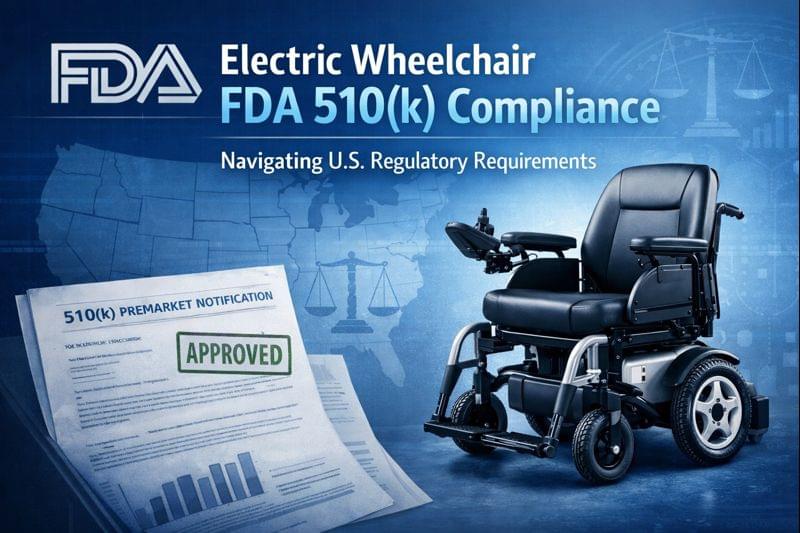
The Exempt Myth: Why Most Electric Wheelchairs Are Not Exempt from FDA 510(k)
Let’s be clear from the outset: almost no standard electric wheelchair is exempt from electric wheelchair FDA 510(k) requirements.
When a supplier claims, “This model is exempt—you don’t need to worry about FDA paperwork,” that statement alone should immediately raise red flags. In the context of electric wheelchair FDA requirements, exemption claims are rarely legitimate and often signal misclassification under U.S. medical device regulations.
Under 21 CFR 890.3860, powered wheelchairs are classified as Class II medical devices. Unlike basic manual wheelchairs or simple mobility aids—which may fall under Class I and be 510(k) exempt—electric wheelchairs require Premarket Notification, commonly known as 510(k) clearance, before they can be legally marketed or imported into the United States.
The Real Clue: The FDA Product Code
The fastest way to determine whether a supplier truly understands electric wheelchair FDA 510(k) rules—or is deliberately misrepresenting them—is to ask one direct question:
“What is the FDA product code for this exact model?”
Every serious importer should immediately recognize the following product codes:
Powered Wheelchair
510(k) required
Motorized Vehicle for Medical Purposes (Medical Scooter)
510(k) required
When exemption claims appear, the device is often incorrectly listed under a manual wheelchair product code, such as IOR, which does not involve an electric motor.
If U.S. Customs or FDA inspectors identify an electric motor on a device declared as a manual wheelchair, the consequences may include shipment detention or seizure, monetary penalties, and import alerts that can disrupt or block future FDA 510(k) electric wheelchair import activity.
Always request the three-letter FDA product code. If the product is electrical and the code is neither IKI nor IST, proceed with extreme caution.
FDA Establishment Registration vs. 510(k) Clearance: The Most Costly Misunderstanding
Confusion between FDA establishment registration and electric wheelchair 510k clearance is responsible for more failed imports than almost any other compliance issue in the electric wheelchair FDA requirements landscape.
Establishment Registration (Factory Registration Only)
Any manufacturer can pay an annual fee and register with the FDA. This process simply informs the FDA who the manufacturer is and where they are located. Establishment registration does not involve product testing, technical review, approval, or clearance—and it does not satisfy the electric wheelchair FDA requirements for market entry.
510(k) Clearance (Product-Level Authorization)
In contrast, 510(k) clearance for electric wheelchairs is a formal FDA review process. The FDA evaluates whether the device is substantially equivalent to a legally marketed predicate device. This review typically includes safety and performance testing (such as ISO 7176 standards), electrical safety evaluation, software validation where applicable, and documented risk analysis.
For Class II devices, electric wheelchair 510k clearance is the regulatory gatekeeper—not factory registration.
The “FDA Certificate” Illusion — Understanding FDA Certificate vs 510k
Many suppliers will provide a polished PDF labeled “FDA Certificate” or “FDA Approval Letter.” These documents are often designed to look official and may feature U.S. flags, eagle emblems, decorative seals, or embossed graphics.
Here is the reality: the FDA does not issue certificates. Official FDA documents generally do not feature the U.S. flag or eagle logos. These PDFs are almost always created by third-party agents and typically do nothing more than confirm that a factory has paid its annual registration fee.
This is where the misunderstanding of FDA certificate vs 510k becomes costly for first-time importers who rely on these documents during FDA 510(k) electric wheelchair import procedures.
What Actually Matters: The K Number
A legitimate electric wheelchair FDA 510(k) clearance is identified by a unique K Number, such as K23XXXX. This number is tied to:
- ✅ A specific device model
- ✅ A specific applicant/manufacturer
- ✅ A publicly searchable FDA database record
Without a valid K Number, any so-called “FDA certificate” has zero regulatory value when clearing a Class II electric wheelchair through U.S. Customs or during any electric wheelchair FDA 510(k) review.
The Hidden Risk: You Are the “Initial Importer”
Many B2B buyers overlook a critical reality: the moment you import an electric wheelchair into the United States, the FDA legally defines you as the Initial Importer.
In practical terms, the FDA does not care who manufactured the wheelchair. They care who brought it into the U.S. market. Even if you never touched a battery, controller, or frame, regulatory responsibility transfers to you. This is one of the most misunderstood aspects of electric wheelchair FDA requirements.
What the Initial Importer Is Legally Responsible For
As an Initial Importer, you assume post-market obligations under U.S. medical device regulations:
Medical Device Reporting (MDR)
Serious injuries, deaths, or device malfunctions must be reported to the FDA—often within 30 days, sometimes sooner depending on severity.
Complaint Handling & Investigation
You must maintain formal complaint files, evaluate each complaint for reportability, and document corrective actions under electric wheelchair FDA requirements.
Corrections and Removals (Recalls)
If a defect is identified—battery overheating, brake failure, controller malfunction—you are responsible for recalls, regardless of where the product was manufactured.
These obligations exist even when the device holds a valid electric wheelchair 510k clearance.
Why Supplier Quality Determines Your Risk Exposure
This is where the difference between a compliant OEM partner and a low-cost supplier becomes visible. A professional electric wheelchair manufacturer supporting electric wheelchair FDA 510(k) clearance will provide complete technical documentation, failure analysis reports, and regulatory cooperation during FDA inquiries.
Low-end suppliers, by contrast, often disappear the moment legal responsibility arises—leaving the Initial Importer exposed to enforcement actions, civil liability, and long-term import restrictions.
For experienced importers, electric wheelchair FDA 510(k) compliance is not just about market entry—it is about surviving post-market oversight once the product is in real-world use.
A Three-Step FDA Vetting Checklist — Five Minutes That Can Save Millions
Before issuing a purchase order, perform this basic compliance check. For FDA 510(k) electric wheelchair import, these five minutes can determine whether your shipment clears U.S. Customs—or never leaves the port.
Step 1: Ask for the K Number
Do not ask, “Is this FDA approved?” That question invites meaningless answers.
Ask instead: “What is the 510(k) number for this exact electric wheelchair model?”
A compliant manufacturer involved in electric wheelchair 510k clearance can answer this question clearly and immediately. If the supplier hesitates, redirects the conversation, or sends a generic certificate instead—that is already your answer.
Step 2: Verify the K Number Yourself
Go directly to the FDA 510(k) Premarket Notification Database and search the K number. Never rely solely on supplier-provided screenshots or PDFs. Confirm the following:
- ✅ Applicant Name matches the actual manufacturer
- ✅ Device Name matches the model you intend to import
- ✅ Product Code is IKI or IST, not a manual wheelchair code
Always open and read the 510(k) Summary. If the summary describes a bulky, lead-acid powered wheelchair from a decade ago—but the product you are importing is a modern lithium-battery or carbon-fiber model—the K number is being misused. At U.S. Customs, a visual mismatch alone can be sufficient grounds for detention under electric wheelchair FDA requirements.
Step 3: Confirm Device Listing Status
Visit the FDA Establishment Registration and Device Listing Database. Search the manufacturer’s legal name and confirm that the specific electric wheelchair model is listed and marked as Active.
If a factory holds FDA establishment registration but has no active device listings for electric wheelchairs, it cannot legally export those products for FDA 510(k) electric wheelchair import into the U.S. market.
Electric Wheelchair FDA 510(k) and the Bigger Market Picture
Understanding electric wheelchair FDA 510(k) requirements is not just about regulatory survival—it is about long-term market strategy. Compliance determines whether your product can enter the U.S. at all, but it does not determine whether your business will succeed once it gets there.
After clearance comes competition: pricing pressure, battery technology evolution, hospital procurement trends, and regional demand shifts across North America, Europe, the Middle East, and emerging markets. Importers who treat FDA 510(k) as a checkbox often miss the bigger picture of where the global electric wheelchair market is actually heading.
To place FDA compliance in its proper commercial context, we recommend continuing with our in-depth market analysis that covers demand drivers, product segmentation, regional growth patterns, and how regulatory readiness directly impacts global competitiveness across the Asian wheelchair manufacturing supply chain.
Global Electric Wheelchair Market 2026 – Trends, Demand & Strategic Insights
Read the Full Market Analysis →Need FDA-Compliant Electric Wheelchairs?
Satcon Medical provides fully documented electric wheelchairs with valid FDA 510(k) clearance, ready for U.S. market import. Contact our team for K number verification, product specifications, and bulk pricing.