In the global rehabilitation equipment industry, one fact is nearly indisputable: the vast majority of electric wheelchairs ultimately originate from the Asian electric wheelchair supply chain.
A decade ago, international buyers looked to Asian manufacturing primarily for its “price advantage.” Today, that view is clearly outdated. What truly sustains Asia’s long-term dominance is a highly integrated, nearly irreplaceable industrial ecosystem.
Understanding this is essential for any overseas brand or importer aiming to establish a stable and competitive electric wheelchair product line.
1. Why Asia Leads in Electric Wheelchair Manufacturing
The leadership of electric wheelchair manufacturers in Asia is not accidental—it is the result of decades of deep industrial clustering and specialized supply chains.
In major manufacturing hubs, particularly China’s Yangtze River Delta and Pearl River Delta, the Chinese electric wheelchair manufacturing ecosystem has refined what the industry often calls the “Two-Hour Supporting Circle.”
Within a 50-kilometer radius of a final assembly facility, manufacturers can typically source over 90% of critical tier-one and tier-two components—including motors, controllers, aluminum extrusion profiles, and specialized surface treatment services.
For international buyers, this level of industrial concentration delivers clear and measurable advantages:
⚙️ Minimized Communication Friction
Engineering teams can resolve design or quality issues face-to-face, enabling rapid iteration and real-time problem solving.
📦 Reduced Inventory Risk
Highly localized suppliers support just-in-time component delivery, lowering stock pressure and cash flow exposure.
⏱️ Shorter Lead Times
The transition from design confirmation to mass production is significantly faster than in fragmented, multi-country supply chains
2. Dissecting the “Golden Triangle” of Power Mobility Production
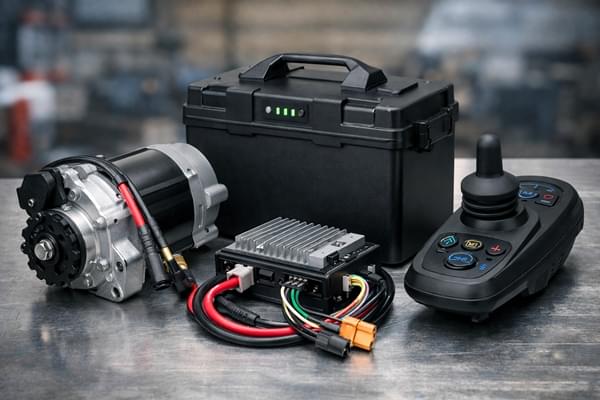
The Strength of the “Three-Power” System
The core competitiveness of any electric wheelchair lies in three key components: Motor, Battery, and Controller. How these are sourced and integrated largely determines the product’s performance, cost, and reliability.
🔋 Battery Technology
Manufacturers in Asia benefit from the world’s largest lithium-ion battery supply chain. By leveraging technological spillovers from the electric vehicle (EV) industry, wheelchairs now offer higher energy density, longer range, and improved safety—all at a lower unit cost. For buyers, this means more reliable, durable products without inflating procurement budgets.
⚡ Motor Innovation
The adoption of high-efficiency brushless motors has advanced faster in Asia due to local access to rare-earth magnetic materials and a well-established micro-motor manufacturing ecosystem. This local supply chain enables faster iterations, better efficiency, and longer operational life, especially important for high-performance and heavy-duty wheelchair models.
🖥️ Controller Integration
While premium models still rely on international brands such as PG or Dynamic, the development of high-quality local controllers provides a cost-effective alternative for mid-range wheelchairs. These controllers offer flexible configuration options and fast response times, giving buyers more freedom to tailor products to their market needs.
Advanced Materials and Structural Engineering
Asian manufacturers offer one of the most complete supply chains for aluminum extrusion, precision welding, and structural components. From lightweight aerospace-grade aluminum to high-strength carbon fiber for premium models, material sourcing is largely local.
Surface treatments—including powder coating, anodizing, and anti-corrosion finishes—are handled by high-capacity, compliant factories. This ensures a stable, long-term supply, even as environmental standards tighten, allowing buyers to maintain consistent product quality without disruption.
The Shift to Automated “Smart” Manufacturing
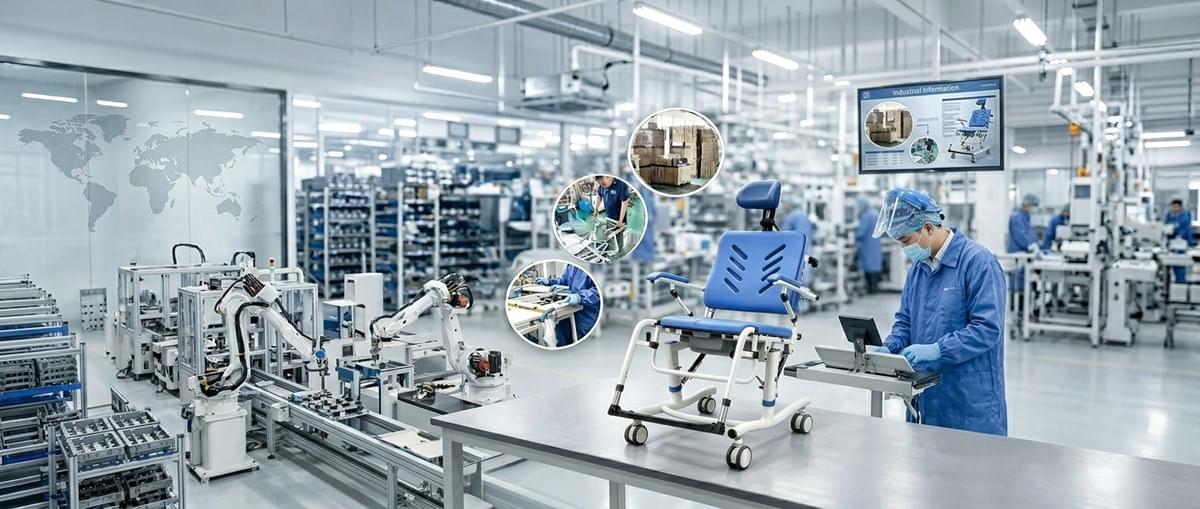
The stereotype of a labor-intensive workshop no longer applies. Leading electric wheelchair OEMs in Asia now employ robotic welding arms, CNC machining centers, and automated assembly lines.
Automation goes beyond efficiency—it ensures structural consistency, precise tolerances, and higher first-pass yield rates. Buyers benefit from products that are uniform in quality, reducing maintenance issues, returns, and warranty claims, while helping to protect brand reputation in competitive markets.
Strategic Takeaways for Buyers
Understanding this “Golden Triangle” of Motor, Battery, and Controller, along with advanced materials and smart manufacturing, allows buyers to:
Anticipate future upgrades and product iterations supported by Asia’s agile supply chain
Identify manufacturers capable of delivering consistent quality at scale
Leverage cost-effective alternatives without compromising safety
3. Asia vs. Western Manufacturing: A Comparative Analysis
When evaluating a manufacturing partner, professional buyers rarely look at the Ex-Works price alone. What matters more is the Total Landed Cost (TLC)—the full cost of delivering finished products to your warehouse, including logistics, tariffs, quality control, and risk mitigation. In this context, the differences between Asian supply chains and Western manufacturing are far more than financial; they influence speed, flexibility, and resilience, which are critical for the fast-moving electric wheelchair market.
| Metric | Asian Supply Chain 🌏 | Western Manufacturing 🌍 |
| 💰 Cost Efficiency | High economies of scale, lower amortized tooling costs, and strong local supplier networks reduce overhead and shipping expenses. | Higher overhead due to labor premiums, unionized workforce, and strict environmental compliance; smaller supplier pools increase component costs. |
| ⚡ R&D Agility | 7–10 days from design freeze to functional prototype; close proximity of tier-one and tier-two suppliers enables rapid iteration and problem-solving. | 7–10 days from design freeze to functional prototype; proximity of tier-one and tier-two suppliers enables rapid iteration and problem-solving. |
| 🛡️ Supply Resilience | Massive capacity pools with multi-tier backup suppliers; the cluster effect provides flexibility to scale production quickly in response to demand spikes. | Longer, more fragile supply chains; limited buffer capacity makes it vulnerable to disruptions in raw material availability or shipping delays. |
This “Agility Gap” is not just a theoretical concept—it directly affects your Time-to-Market. For example, trends such as ultra-lightweight, foldable wheelchairs or high-end outdoor mobility models emerge rapidly. Companies relying on Western supply chains may only bring these products to market months later, missing early adoption opportunities. In contrast, Asia-based manufacturers can respond within weeks, giving buyers a significant competitive advantage.
Moreover, supply chain resilience matters during unexpected market shifts or global disruptions. Asia’s multi-tier supplier networks and capacity redundancy mean production can continue with minimal interruption. In Western manufacturing, where suppliers are often spread across multiple countries, any disruption—whether raw material shortages, transportation delays, or regulatory hurdles—can cascade through the supply chain, delaying deliveries and increasing risk.
For international buyers, understanding these differences is crucial. Choosing a partner with a robust, agile, and integrated supply chain in Asia is not just about reducing cost—it’s about securing predictable lead times, faster product iteration, and the ability to meet fluctuating demand without compromising quality.
4. The “China + 1” Strategy: Southeast Asia as a Strategic Extension
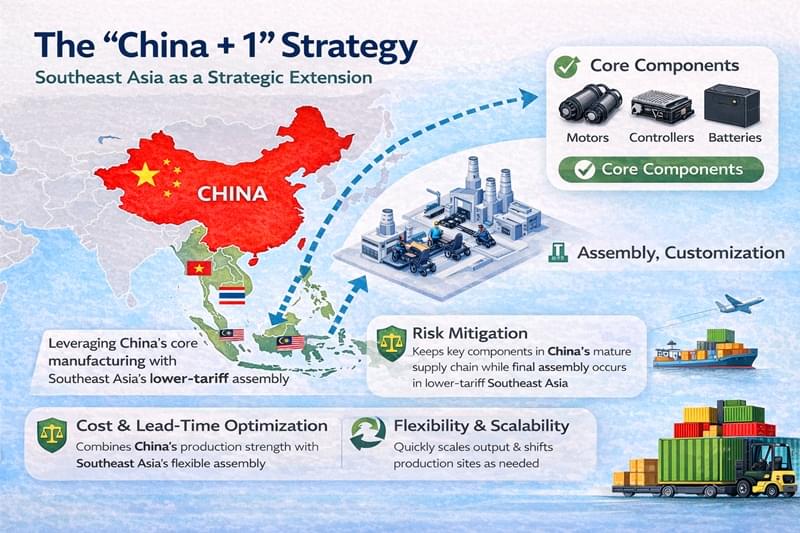
In response to shifting global trade policies and tariffs, many electric wheelchair manufacturers in Asia have adopted a “China + 1” strategy. Under this model, the core components—motors, batteries, and controllers—are sourced directly from the China electric wheelchair manufacturing ecosystem 🌏, leveraging its mature supply chain, technical reliability, and quality standards. Meanwhile, countries such as Vietnam, Thailand, and Malaysia handle final assembly, minor production steps, or specific customization 🏭, allowing buyers to navigate tariff and regulatory complexities in key export markets.
Asia, particularly China, has become the backbone of the global electric wheelchair supply chain, thanks to mature manufacturing ecosystems, scalable production capacity, and integrated component sourcing—making a reliable electric wheelchair manufacturer in China a strategic choice for long-term global sourcing.
This approach offers several advantages for international buyers:
- ⚖️ Risk Mitigation: By keeping critical components within China’s well-established supply network, companies avoid compromising quality or technical consistency, while still benefiting from local assembly in lower-tariff regions.
- ⏱️ Cost and Lead-Time Optimization: Southeast Asian facilities, working in close coordination with Chinese suppliers, help reduce logistics bottlenecks and shorten production cycles for global distribution.
- 🔄 Flexibility and Scalability: The dual-region setup allows manufacturers to quickly adjust production volumes or switch assembly locations in response to market demand or policy changes, without disrupting core component supply.
For brands and importers, the China + 1 model is not just a workaround for tariffs—it is a strategic solution that combines the strengths of China electric wheelchair manufacturing 🌏 with the agility of regional production hubs, ensuring consistent quality, timely delivery, and competitive cost structures 💼.
5. Looking Ahead: The 2025–2030 Outlook
Over the next five years, the Asian electric wheelchair supply chain is expected to move beyond traditional manufacturing, evolving into a more integrated, system-oriented model. Buyers and brands should understand these changes to plan procurement, product development, and global market strategies effectively.
💻 Digital Transparency
More manufacturers are adopting ERP and MES systems, enabling real-time monitoring of production progress. For international buyers, this means better visibility into lead times, quality checks, and assembly status. Decisions such as batch shipments or urgent orders can be made with accurate, up-to-date data rather than estimates. This shift is particularly valuable for companies managing multiple markets or complex product lines.
🌱 ESG Compliance and Green Manufacturing
Asian factories are accelerating the adoption of eco-friendly production methods, including carbon-neutral energy, low-VOC coatings, and recyclable materials. This ensures compliance with European and North American environmental standards, making it easier for buyers to meet their own sustainability commitments. For brands targeting ESG-conscious clients or public sector tenders, this development directly affects product eligibility and market access.
🧩 Modular Design and Local Service Optimization
Manufacturers are increasingly designing modular wheelchairs, where components such as batteries, motors, and seating modules can be replaced or upgraded locally. For buyers, this offers several advantages: simplified maintenance, reduced shipping of complete units for minor repairs, and extended product lifespan. It also allows distributors and service partners to provide faster, lower-cost support, improving customer satisfaction and retention.
📈 Strategic Implications for Buyers
Overall, these trends indicate that selecting the right electric wheelchair OEM is no longer just about unit price. Buyers now need to evaluate digital capabilities, ESG compliance, and modular design readiness when assessing partners. Suppliers who can combine technical reliability with operational transparency will be critical in supporting global expansion and long-term growth.
6. The Evolving Edge of Asian Electric Wheelchair Supply Chains
The competitive advantage of Asian supply chains has moved beyond simply offering low prices. Today, success comes from seamless vertical integration, technical adaptability, and reliable manufacturing standards. Partnering with the right electric wheelchair OEM means more than purchasing a product—you’re tapping into one of the world’s most advanced mobility networks 🌏.
For a closer look at global trends, market growth, and industry insights, explore our Global Electric Wheelchair Market Report 2026 📄.