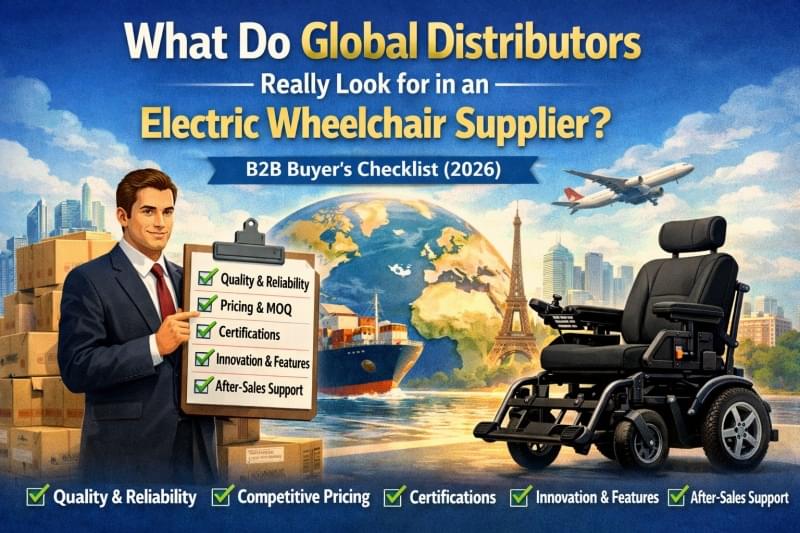
When global distributors evaluate an electric wheelchair supplier, they are not just buying a product — they are assessing long-term business risk. A wheelchair that fails in the field, lacks spare parts support, or misses local certification creates losses far beyond the initial purchase price. This guide breaks down exactly how to choose an electric wheelchair supplier, based on real B2B sourcing experience from North America, Europe, and Southeast Asia.
☰ Table of Contents
1. Buyer Types: Not All Distributors Are the Same
2. Structural Durability: The First Thing Experienced Buyers Check
3. Battery Performance: The Factor That Decides Market Viability
4. Foldable Design: The Logistics Factor That Impacts Every SKU
5. Electric Wheelchair Spare Parts: The #1 Reason Distributors Switch Suppliers
6. Wholesale Pricing: Profit Structure Matters More Than the FOB Number
7. EN12184 Electric Wheelchair Compliance: Your Passport to Regulated Markets
8. Product Design: The Commercial Factor Most Chinese Factories Underestimate
9. Your B2B Buyer’s Checklist: How to Choose an Electric Wheelchair Supplier
1. Buyer Types: Not All Distributors Are the Same
Before evaluating any wholesale electric wheelchair supplier, understand your buyer profile:
🏥 Medical Distributors
hospitals, rehab centers, nursing homes
Prioritize: Clinical compliance · Durability · Spare parts availability
🏪 Retail & Pharmacy Chains
chain stores, independent pharmacies
Prioritize: Pricing · Ease of use · Compact folding design
📦 E-Commerce Sellers (FBA)
Amazon, eBay, Shopify sellers
Prioritize: Packaging dimensions · Low return rates · Visual appeal
A reliable electric wheelchair supplier adapts to your channel — not the other way around. If you are sourcing a wholesale electric wheelchair for retail or e-commerce, prioritize suppliers who offer a foldable electric wheelchair range, as this format dominates both online sales and pharmacy shelf space globally.
2. Structural Durability: The First Thing Experienced Buyers Check
“Your wheelchair lasted how long in real-world use?” — This is the first question any experienced buyer asks.
Key evaluation points:
Frame Material & Welding Quality
In developed markets, aerospace-grade 6061 aluminum alloy with TIG welding is now the baseline expectation. Smart buyers inspect weld seams at trade shows. Uneven welds, porosity, or lack of fusion — all visible in under 10 seconds.
Rated Load vs. Real-World Performance
A rated capacity of 120 kg means nothing if the frame deforms after 6 months of daily use. Buyers increasingly ask: “Do you have long-term fatigue test data?”
Component Lifespan
Motors, controller boards, and joystick modules are the top sources of after-sales complaints globally. Distributors prefer electric wheelchair supplier partners who provide MTBF (Mean Time Between Failures) data upfront.
💡 Tip: Ask for welding inspection photos and factory audit reports. A credible supplier produces these on demand.
3. Battery Performance: The Factor That Decides Market Viability
Battery is not a spec sheet checkbox. It directly affects user experience, airline compliance, and return rates. Distributors focus on three questions:
Real-World Driving Range
Can the advertised 20 km range actually be achieved under normal load and terrain conditions? Buyers from hilly regions (the Swiss Alps, rural Japan, the US East Coast) will test this without warning.
Battery Chemistry
Lithium batteries dominate mid-to-high-end models. LiFePO4 (LFP) batteries are increasingly seen as a differentiator — lower fire risk, thermal stability, and 2,000+ cycle life vs. 500 cycles for standard lithium-ion.
Airline Compliance
IATA regulations cap the lithium batteries in checked luggage at 300 Wh. Many travel-focused distributors require ≤ 270 Wh with documentation. This rule has directly reshaped product design since 2022.
When sourcing a wholesale electric wheelchair, emphasize: battery capacity in Wh (not just Ah), cell brand (CATL, Samsung SDI), and IATA compliance documentation.
4. Foldable Design: The Logistics Factor That Impacts Every SKU
For foldable electric wheelchair products, the folding mechanism and shipping dimensions can make or break a SKU for e-commerce sellers.
- Single-step folding reduces Amazon return rates by 30–40%, according to sellers who made the switch. One return = $15–20 in lost fees and shipping — for a business running 200 units a month, that is real money.
- Folded dimensions (target: < 75 × 60 × 35 cm) determine whether your product qualifies for air freight, which directly affects delivery speed and end-user purchase decisions.
- Carton design optimization for LCL shipping can save $3–5 per unit. For a distributor shipping 200 units monthly, that is over $7,000 annually.
Medical distributors care less about folding speed and more about compact clinical storage and easy vehicle transfer between rooms or facilities.
5. Electric Wheelchair Spare Parts: The #1 Reason Distributors Switch Suppliers
This is the most common complaint about China-based electric wheelchair supplier partners:
“Spare parts took 8 weeks to arrive.”
“The replacement controller board was a different version — joystick incompatibility.”
“Three emails sent. No response for two weeks.”
What B2B buyers expect from electric wheelchair spare parts support:
| Factor | Buyer Expectation |
|---|---|
| Spare parts availability | Key components (joystick, controller, motor) within 2 weeks |
| Component compatibility | Backward compatibility across model years |
| Technical documentation | Wiring diagrams, exploded views, service manuals |
| Support response time | Email reply within 24 hours with a dedicated contact |
| Training resources | Video tutorials for common repairs |
An electric wheelchair supplier with a structured spare parts system retains distributors longer and earns more repeat orders — especially in Germany and Australia, where end-user expectations are highest.
6. Wholesale Pricing: Profit Structure Matters More Than the FOB Number
Distributors sourcing wholesale electric wheelchair products are not just comparing FOB prices. They are calculating a full cost structure:
| Cost Item | European Market Range (USD) |
|---|---|
| FOB price | $450–$600 |
| International freight | $80–$150 |
| Import duties & clearance | $60–$120 |
| Local logistics & storage | $50–$100 |
| Warranty reserve | $30–$60 |
| Distributor margin (25%–45%) | $150–$350 |
Typical pricing tiers:
- North America / Europe: $350–$650 FOB (foldable lightweight models)
- Southeast Asia / Middle East: $200–$400 FOB (economy to mid-range)
- Institutional buyers: flexible pricing, compliance-first
MOQ flexibility is the first gate for new suppliers. Many factories start with 50+ unit MOQs, but most new-market distributors want to test with 10–20 unit trial orders first. An electric wheelchair supplier who offers flexible MOQ with a clear volume pricing ladder builds long-term relationships faster.
7. EN12184 Electric Wheelchair Compliance: Your Passport to Regulated Markets
For distributors targeting Europe, North America, or Australia, certification is not optional — it is the entry fee.
Core certifications by market:
- 🇬🇧 Europe: CE marking + EN12184 electric wheelchair standard (mandatory under EU MDR 2017/745)
- 🇺🇸 United States: FDA 510(k) registration
- 🌏 Southeast Asia / Middle East: varies by country — verify individually
The EN12184 electric wheelchair standard covers structural strength, braking performance, battery safety, and electromagnetic compatibility. It is the cornerstone document for European market access.
Distributors do not always require the manufacturer to hold the certification — but they need test reports, technical files, and a responsive team willing to support local compliance processes. A supplier with TÜV or SGS test reports carries significantly more credibility in European markets.
📋 Related: Electric Wheelchair CE Certification and EN12184 Compliance Guide →
8. Product Design: The Commercial Factor Most Chinese Factories Underestimate
End-user purchase decisions are heavily influenced by product appearance. A wheelchair that looks clinical and dated stays in the showroom. One that looks lifestyle-oriented sells — and gets recommended.
Modern design elements that matter:
- 🎨 Color customization (frame colors + seat upholstery options)
- 🕹 Compact joystick with intuitive display
- 🔌 Clean cable routing (no exposed wiring)
- 🧺 Breathable mesh seat vs. traditional foam padding
The rise of lifestyle-oriented mobility products — driven by Baby Boomers who refuse devices that look “medical” — has made aesthetics a genuine commercial factor in North America, Australia, and Northern Europe.
9. Your B2B Buyer’s Checklist: How to Choose an Electric Wheelchair Supplier
Before choosing an electric wheelchair supplier, verify:
☑ Durability verified — TIG-welded 6061 aluminum frame, fatigue test data available
☑ Battery performance confirmed — real-world range, LFP chemistry, IATA compliance documentation
☑ Foldable design validated — single-step mechanism, FBA-compliant dimensions, optimized carton
☑ Electric wheelchair spare parts system in place — 2-week availability, backward compatibility, technical docs
☑ Pricing structure clear — FOB, logistics, duties, and margin ladder all transparent
☑ EN12184 electric wheelchair compliance supported — test reports, technical files, audit-ready documentation
☑ Communication standard set — 24-hour response, dedicated account contact
If a supplier cannot clear these checkpoints, you are buying a product — not a partnership.
The real answer to how to choose electric wheelchair supplier starts with knowing what to ask — and this checklist gives you exactly that.
Conclusion
How to choose an electric wheelchair supplier is not a question answered by a spec sheet comparison. It is answered by assessing long-term reliability, compliance support, spare parts responsiveness, and commercial transparency.
Distributors who build lasting B2B partnerships do not select suppliers based on price alone. They choose partners who think like distributors — who understand that product failure costs more than the price difference, that spare parts availability is a competitive advantage, and that compliance documentation is a sales tool.
Start your supplier evaluation with a 10–20 unit trial order. A reliable electric wheelchair supplier will welcome that — and earn the rest.
Need a supplier profile or product specification sheet?
Sources
• Mordor Intelligence, Power Wheelchair Market Report, 2024
• IATA Dangerous Goods Regulations, 2024 Edition
• EN12184:2022 European Standard for Powered Wheelchairs