Introduction: The Real Cost of a Wheelchair Isn’t the Price — It’s the Hidden Lifetime Cost
In the global medical mobility industry, the true cost of a wheelchair goes far beyond its FOB price. Total cost of ownership (TCO) includes returns, warranty claims, logistics, and distributor trust. Choosing a reliable wheelchair factory supplier helps reduce these hidden costs and ensures consistent quality.
A dependable wheelchair cannot rely solely on final inspection. Quality must be built into the manufacturing process from the start. For distributors asking how to choose a wheelchair supplier, understanding the supplier’s certifications, processes, and quality protocols is essential for reliability and performance.
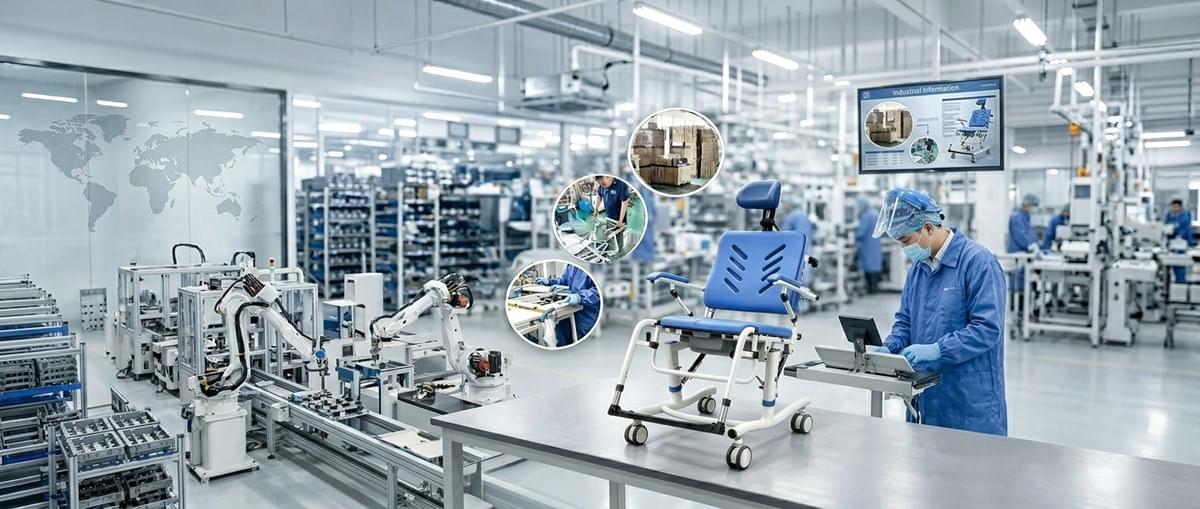
We follow “transparent manufacturing” to show buyers how quality is created. From raw materials and process control to lab validation, each step manages risk. Partnering with a trusted wheelchair factory supplier and knowing how to choose a wheelchair supplier ensures durable, reliable products and peace of mind for distributors.
Stage 1 – Incoming Quality Control (IQC) ✅
Quality begins at the material stage, and a top-tier wheelchair factory supplier knows that reliability starts with raw materials. Every aluminum frame, battery cell, motor, and electronic component is inspected for compliance with ISO 7176 standards.
- 🔧 Material Verification: Aluminum tubing is tested for hardness, composition, and dimensional accuracy. Only batches that meet aerospace-grade strength-to-weight ratios are approved.
- ⚡ Battery Consistency: Each lithium-ion cell is capacity-graded and impedance-matched to ensure uniform performance. This reduces the risk of early battery failure in electric wheelchair manufacturer products.
- 📊 Supplier Tracking: On-time delivery (OTD), defect rates, and material consistency are recorded in a vendor scoring system to ensure a reliable global supply chain.
By rigorously applying IQC protocols, suppliers guarantee that the production line only processes high-quality inputs, forming the foundation for dependable wheelchair quality control.
Stage 2 – In-Process Quality Control (IPQC) 🔧
Once materials enter production, controlling variability is key. Automated and standardized processes ensure that every unit meets strict performance standards.
- 🤖 Robotic Welding Consistency: Core frame components are welded by robotic arms to ensure uniform penetration, bead consistency, and structural integrity. This is crucial for long-term durability in both manual and electric wheelchair manufacturer products.
- 📏 First Article Inspection (FAI): Each batch starts with a precision measurement of the first unit against engineering schematics. Only after approval does mass production continue.
- ⚡ Electronic Burn-In Testing: All controllers, joysticks, and batteries undergo a 24-hour powered aging test under load to detect early-life failures.
IPQC ensures that production variability is minimized, providing consistent quality across every order and safeguarding B2B wheelchair distribution reliability.
Stage 3 – Accelerated Life Testing (ALT) ⚡
Accelerated Life Testing simulates years of real-world usage to verify durability and structural integrity.
- 🥁 Double Drum Fatigue Testing: Wheelchairs undergo over 200,000 cycles on rotating drums to simulate curbs, uneven pavements, and repeated mechanical stress.
- 📦 Drop & Packaging Testing: Units are subjected to ISTA-standard drop tests to ensure packaging protects products during transit.
- 🌊 Salt-Spray Corrosion Testing: Metal components are exposed to saline fog for 48–72 hours to test resistance in humid or coastal regions.
ALT not only ensures compliance with ISO standards but also guarantees that private label wheelchair factory products maintain high quality and durability, critical for distributor confidence
Stage 4 – Outgoing Quality Control (OQC) 📦
Before shipment, every wheelchair undergoes a rigorous final inspection to confirm performance, safety, and completeness.
- ✅ Functional Testing: Manual units are checked for folding mechanisms, brakes, and frame alignment; electric models are tested for motor response, battery performance, and BMS protection.
- 🎯 Order Verification: Accessories, packaging, and labels are matched with order specifications.
- 📊 Defect Tracking: OQC records are maintained to prevent recurrent issues and ensure a high level of trust in wheelchair factory supplier relationships.
This step ensures distributors receive products that meet expectations, reducing warranty claims and returns.
Stage 5 – Documentation & Traceability 📑
Transparency is essential for B2B partnerships and compliance. Every shipment includes detailed documentation that verifies quality control throughout the production process.
- 📑 QC Reports: Material tests, welding logs, burn-in results, ALT reports, and OQC checklists provide verifiable proof of compliance.
- 🌐 Regulatory Support: Complete documentation aids CE/FDA registration, tender submissions, and after-sales support.
- 🔒 Traceability: Each unit is linked to production data, making it easy to track quality history, support warranties, and enhance trust in the electric wheelchair manufacturer and private label wheelchair factory.
By combining rigorous QC with transparent documentation, suppliers help distributors make confident purchasing decisions while maintaining brand integrity.
Stage 6 – Packaging & Logistics Optimization ✅
Ensuring the integrity of precision medical devices is critical in today’s fast-moving global logistics environment. Even the most robust wheelchairs can be damaged during cross-border transportation if packaging is inadequate. At Satcon Medical, we see packaging not just as a container but as a carefully engineered protection system designed to meet ISTA (International Safe Transit Association) standards.
Key Logistics Processes:
✅ Structural Packaging Integrity: High-strength 7-layer corrugated cardboard (triple-wall cartons) provides exceptional crush resistance. Unlike standard retail packaging, these cartons can withstand heavy stacking, lateral impacts, and other stresses encountered during ocean freight and port handling.
✅ Custom Molded Cushioning: Ordinary fillers cannot protect sensitive electronics. We use custom-molded EPE or EPS foam inserts that perfectly fit the wheelchair’s geometry.
✅ Volume Loading Optimization: Shipping costs are a key component of unit landed cost. Our logistics team uses 3D container planning software to maximize cubic utilization. By reducing “space,” we typically load 10–15% more units per 40-ft high-cube container, directly lowering per-unit freight for distributors.
Conclusion
In global supply chains, a lack of transparency is a major risk. At Satcon Medical, we aim to turn supplier-distributor relationships from transactional exchanges into strategic partnerships by openly sharing our production and quality control processes.
By strictly following our six-stage quality control system—from metallurgical verification of raw aluminum to logistics optimization—we strive for a shared business goal: minimizing your after-sales liability. Lower defect rates translate to reduced warranty costs, fewer customer complaints, and a stronger, more resilient brand reputation in local markets.
Choosing the right wheelchair factory supplier is a strategic decision for B2B distributors and brands. By emphasizing rigorous wheelchair quality control, ISO-standard testing, and private label flexibility, distributors gain reliable products, minimize operational risks, and enhance brand value. Aligning with a trusted electric wheelchair manufacturer ensures a sustainable, transparent, and efficient global supply chain